GS8330DW72
GS8330DW72 is 36M Double Late Write SRAM manufactured by GSI Technology.
- Part of the GS8330DW36 comparator family.
- Part of the GS8330DW36 comparator family.
Preliminary GS8330DW36/72C-250/200
209-Bump BGA mercial Temp Industrial Temp
36Mb Σ1x1Dp CMOS I/O
Double Late Write Sigma RAM™
200 MHz- 250 MHz 1.8 V VDD 1.8 V I/O
Features
- Double Late Write mode, Pipelined Read mode
- JEDEC-standard Sigma RAM™ pinout and package
- 1.8 V +150/- 100 m V core power supply
- 1.8 V CMOS Interface
- ZQ controlled user-selectable output drive strength
- Dual Cycle Deselect
- Burst Read and Write option
- Fully coherent read and write pipelines
- Echo Clock outputs track data output drivers
- Byte write operation (9-bit bytes)
- 2 user-programmable chip enable inputs
- IEEE 1149.1 JTAG-pliant Serial Boundary Scan
- 209-bump, 14 mm x 22 mm, 1 mm bump pitch BGA package
- Pin-patible with future 72Mb and 144Mb devices Key Fast Bin Specs Cycle Time Access Time Symbol t KHKH t KHQV -250 4.0 ns 2.1 ns
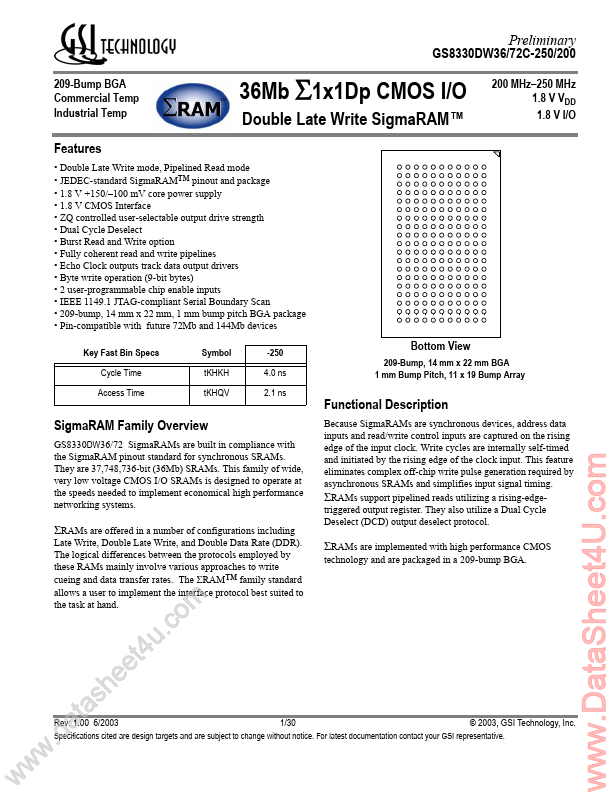
Bottom View
209-Bump, 14 mm x 22 mm BGA 1 mm Bump Pitch, 11 x 19 Bump Array
Functional Description
Because Sigma RAMs are synchronous devices, address data inputs and read/write control inputs are captured on the rising edge of the input clock. Write cycles are internally self-timed and initiated by the rising edge of the clock input. This feature eliminates plex off-chip write pulse generation required by asynchronous SRAMs and simplifies input signal timing. ΣRAMs support pipelined reads utilizing a rising-edgetriggered output register. They also utilize a Dual Cycle Deselect (DCD) output deselect protocol.
Sigma RAM Family Overview
GS8330DW36/72 Sigma RAMs are built in pliance with the Sigma RAM pinout standard for synchronous SRAMs. They are 37,748,736-bit (36Mb) SRAMs. This family of wide, very low voltage CMOS I/O SRAMs is designed to operate at the speeds needed to implement economical high performance networking systems.
ΣRAMs are offered in a number of configurations including
Late Write, Double Late Write, and Double Data Rate (DDR). The logical differences between the protocols employed by these RAMs mainly involve various...