Datasheet4U Logo Datasheet4U.com

MSA-1000 - Cascadable Silicon Bipolar MMIC Amplifier

This page provides the datasheet information for the MSA-1000, a member of the MSA-1000_Hewlett Cascadable Silicon Bipolar MMIC Amplifier family.

Datasheet Summary

Description

The MSA-1000 is a high performance, medium power silicon bipolar Monolithic Microwave Integrated Circuit (MMIC) chip.

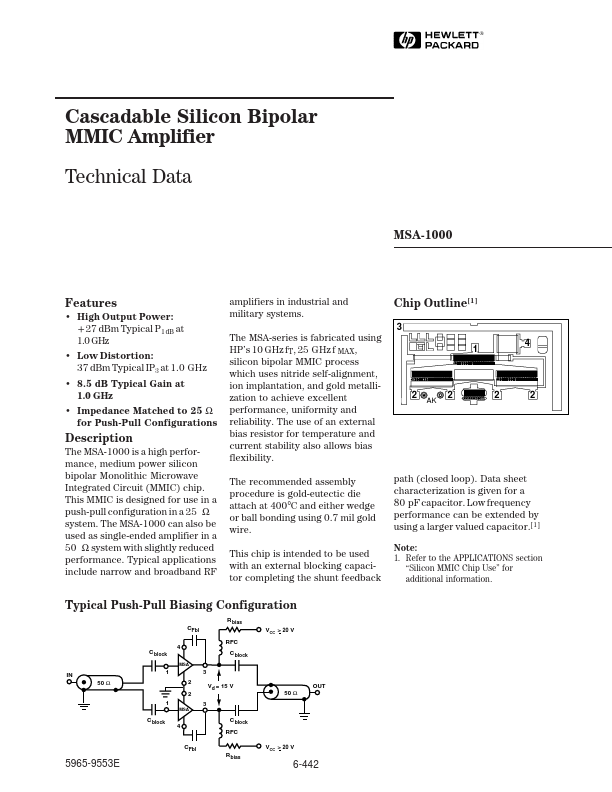
This MMIC is designed for use in a push-pull configuration in a 25␣ Ω system.

Features

  • High Output Power: +27 dBm Typical P1dB at 1.0␣ GHz.
  • Low Distortion: 37 dBm Typical IP3 at 1.0␣ GHz.
  • 8.5 dB Typical Gain at 1.0␣ GHz.
  • Impedance Matched to 25 Ω for Push-Pull Configurations amplifiers in industrial and military systems. The MSA-series is fabricated using HP’s 10 GHz fT, 25␣ GHz f MAX, silicon bipolar MMIC process which uses nitride self-alignment, ion implantation, and gold metallization to achieve excellent performance, uniformity and reliab.

📥 Download Datasheet

Datasheet preview – MSA-1000

Datasheet Details

Part number MSA-1000
Manufacturer Hewlett-Packard
File Size 73.59 KB
Description Cascadable Silicon Bipolar MMIC Amplifier
Datasheet download datasheet MSA-1000 Datasheet
Additional preview pages of the MSA-1000 datasheet.
Other Datasheets by Hewlett-Packard

Full PDF Text Transcription

Click to expand full text
Cascadable Silicon Bipolar MMIC␣ Amplifier Technical Data MSA-1000 Features • High Output Power: +27 dBm Typical P1dB at 1.0␣ GHz • Low Distortion: 37 dBm Typical IP3 at 1.0␣ GHz • 8.5 dB Typical Gain at 1.0␣ GHz • Impedance Matched to 25 Ω for Push-Pull Configurations amplifiers in industrial and military systems. The MSA-series is fabricated using HP’s 10 GHz fT, 25␣ GHz f MAX, silicon bipolar MMIC process which uses nitride self-alignment, ion implantation, and gold metallization to achieve excellent performance, uniformity and reliability. The use of an external bias resistor for temperature and current stability also allows bias flexibility. The recommended assembly procedure is gold-eutectic die attach at 400°C and either wedge or ball bonding using 0.7 mil gold wire.
Published: |