Datasheet4U Logo Datasheet4U.com

MSA-1104 - Cascadable Silicon Bipolar MMIC Amplifier

This page provides the datasheet information for the MSA-1104, a member of the MSA-1104_Hewlett Cascadable Silicon Bipolar MMIC Amplifier family.

Datasheet Summary

Description

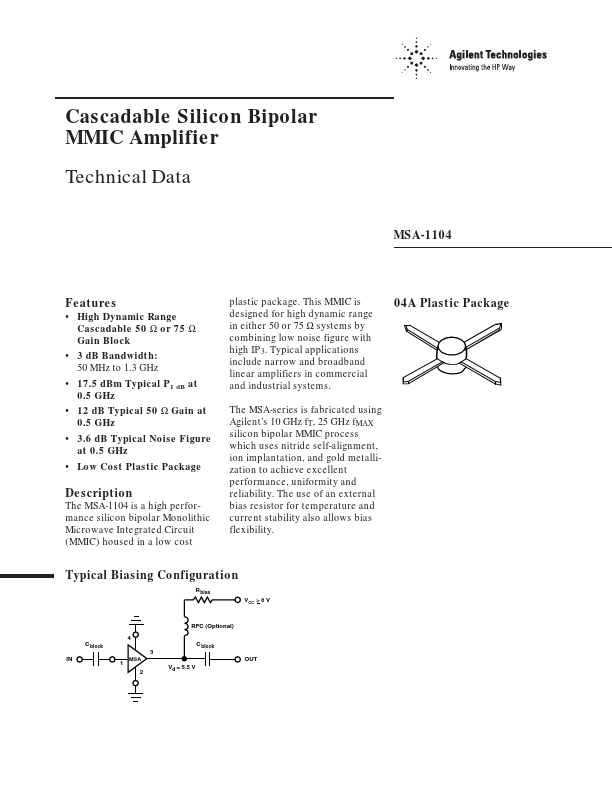
The MSA-1104 is a high performance silicon bipolar Monolithic Microwave Integrated Circuit (MMIC) housed in a low cost Typical Biasing Configuration R bias VCC > 8 V RFC (Optional) 4 C block 3 IN 1 MSA C block OUT Vd = 5.5 V 2 2 MSA-1104 Absolute Maximum Ratings Parameter Device Current Power

Features

  • High Dynamic Range Cascadable 50 Ω or 75 Ω Gain Block.
  • 3 dB Bandwidth: 50 MHz to 1.3 GHz.
  • 17.5 dBm Typical P1 dB at 0.5 GHz.
  • 12 dB Typical 50 Ω Gain at 0.5 GHz.
  • 3.6 dB Typical Noise Figure at 0.5 GHz.
  • Low Cost Plastic Package plastic package. This MMIC is designed for high dynamic range in either 50 or 75 Ω systems by combining low noise figure with high IP3. Typical.

📥 Download Datasheet

Datasheet preview – MSA-1104

Datasheet Details

Part number MSA-1104
Manufacturer Hewlett-Packard
File Size 44.00 KB
Description Cascadable Silicon Bipolar MMIC Amplifier
Datasheet download datasheet MSA-1104 Datasheet
Additional preview pages of the MSA-1104 datasheet.
Other Datasheets by Hewlett-Packard

Full PDF Text Transcription

Click to expand full text
Cascadable Silicon Bipolar MMIC Amplifier Technical Data MSA-1104 Features • High Dynamic Range Cascadable 50 Ω or 75 Ω Gain Block • 3 dB Bandwidth: 50 MHz to 1.3 GHz • 17.5 dBm Typical P1 dB at 0.5 GHz • 12 dB Typical 50 Ω Gain at 0.5 GHz • 3.6 dB Typical Noise Figure at 0.5 GHz • Low Cost Plastic Package plastic package. This MMIC is designed for high dynamic range in either 50 or 75 Ω systems by combining low noise figure with high IP3. Typical applications include narrow and broadband linear amplifiers in commercial and industrial systems. The MSA-series is fabricated using Agilent’s 10 GHz fT, 25 GHz fMAX silicon bipolar MMIC process which uses nitride self-alignment, ion implantation, and gold metallization to achieve excellent performance, uniformity and reliability.
Published: |