

Datasheet4U Logo Datasheet4U.com

IXDP610 - Bus Compatible Digital PWM Controller

Description

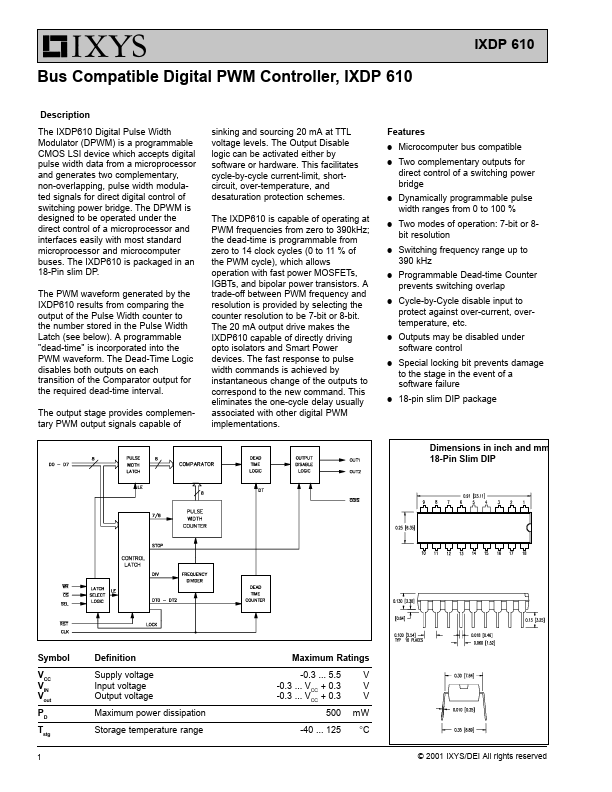
The IXDP610 Digital Pulse Width Modulator (DPWM) is a programmable CMOS LSI device which accepts digital pulse width data from a microprocessor and generates two complementary, non-overlapping, pulse width modulated signals for direct digital control of switching power bridge.

Features

  • G G Microcomputer bus compatible Two complementary outputs for direct control of a switching power bridge Dynamically programmable pulse width ranges from 0 to 100 % Two modes of operation: 7-bit or 8bit resolution Switching frequency range up to 390 kHz Programmable Dead-time Counter prevents switching overlap Cycle-by-Cycle disable input to protect against over-current, overtemperature, etc. Outputs may be disabled under software control Special locking bit prevents damage to the stage in the.

📥 Download Datasheet

Datasheet preview – IXDP610

Datasheet Details

Part number IXDP610
Manufacturer IXYS (now Littelfuse)
File Size 181.71 KB
Description Bus Compatible Digital PWM Controller
Datasheet download datasheet IXDP610 Datasheet
Additional preview pages of the IXDP610 datasheet.
Other Datasheets by IXYS Corporation

Full PDF Text Transcription

Click to expand full text
IXDP 610 Bus Compatible Digital PWM Controller, IXDP 610 Description The IXDP610 Digital Pulse Width Modulator (DPWM) is a programmable CMOS LSI device which accepts digital pulse width data from a microprocessor and generates two complementary, non-overlapping, pulse width modulated signals for direct digital control of switching power bridge. The DPWM is designed to be operated under the direct control of a microprocessor and interfaces easily with most standard microprocessor and microcomputer buses. The IXDP610 is packaged in an 18-Pin slim DP. The PWM waveform generated by the IXDP610 results from comparing the output of the Pulse Width counter to the number stored in the Pulse Width Latch (see below). A programmable "dead-time" is incorporated into the PWM waveform.
Published: |