Datasheet4U Logo Datasheet4U.com

MPM3810GQB - 1.2A Module Synchronous Step-Down Converter

Download the MPM3810GQB datasheet PDF. This datasheet also covers the MPM3810 variant, as both devices belong to the same 1.2a module synchronous step-down converter family and are provided as variant models within a single manufacturer datasheet.

General Description

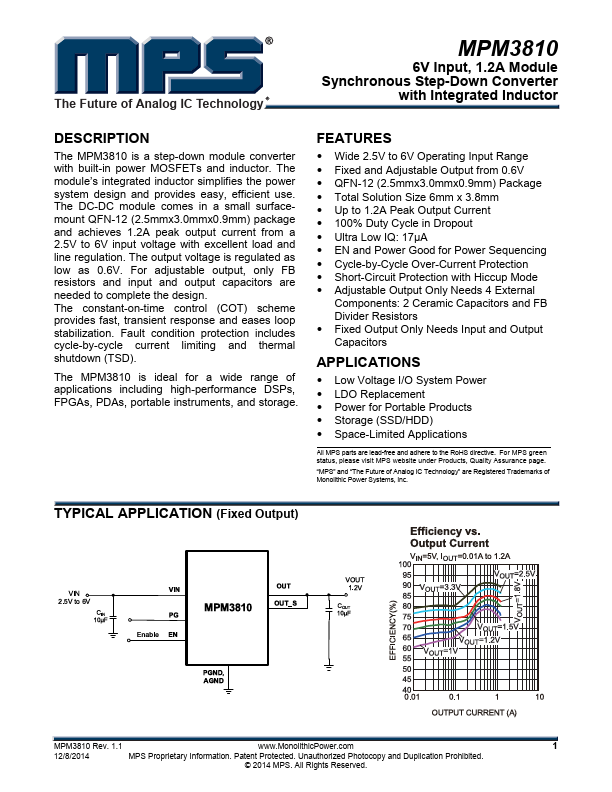
The MPM3810 is a step-down module converter with built-in power MOSFETs and inductor.

The module’s integrated inductor simplifies the power system design and provides easy, efficient use.

Key Features

  • Wide 2.5V to 6V Operating Input Range.
  • Fixed and Adjustable Output from 0.6V.
  • QFN-12 (2.5mmx3.0mmx0.9mm) Package.
  • Total Solution Size 6mm x 3.8mm.
  • Up to 1.2A Peak Output Current.
  • 100% Duty Cycle in Dropout.
  • Ultra Low IQ: 17μA.
  • EN and Power Good for Power Sequencing.
  • Cycle-by-Cycle Over-Current Protection.
  • Short-Circuit Protection with Hiccup Mode.
  • Adjustable Output Only Needs 4 External Components.

📥 Download Datasheet

Note: The manufacturer provides a single datasheet file (MPM3810-MPS.pdf) that lists specifications for multiple related part numbers.

Full PDF Text Transcription (Reference)

The following content is an automatically extracted verbatim text from the original manufacturer datasheet and is provided for reference purposes only.

View original datasheet text
The Future of Analog IC Technology MPM3810 6V Input, 1.2A Module Synchronous Step-Down Converter with Integrated Inductor DESCRIPTION The MPM3810 is a step-down module converter with built-in power MOSFETs and inductor. The module’s integrated inductor simplifies the power system design and provides easy, efficient use. The DC-DC module comes in a small surfacemount QFN-12 (2.5mmx3.0mmx0.9mm) package and achieves 1.2A peak output current from a 2.5V to 6V input voltage with excellent load and line regulation. The output voltage is regulated as low as 0.6V. For adjustable output, only FB resistors and input and output capacitors are needed to complete the design. The constant-on-time control (COT) scheme provides fast, transient response and eases loop stabilization.