Datasheet4U Logo Datasheet4U.com

XR1002-QB - GaAs Receiver

General Description

Absolute Maximum Ratings Supply Voltage (Vd) Supply Current (Id) Gate Bias Voltage (Vg) Input Power (RF Pin) Storage Temperature (Tstg) Operating Temperature (Ta) Channel Temperature (Tch) +6.0 VDC 300 mA +0.3 VDC 0.0 dBm -65 to +165 OC -55 to MTTF Table3 MTTF Table 3 (1) Measured using constant c

Key Features

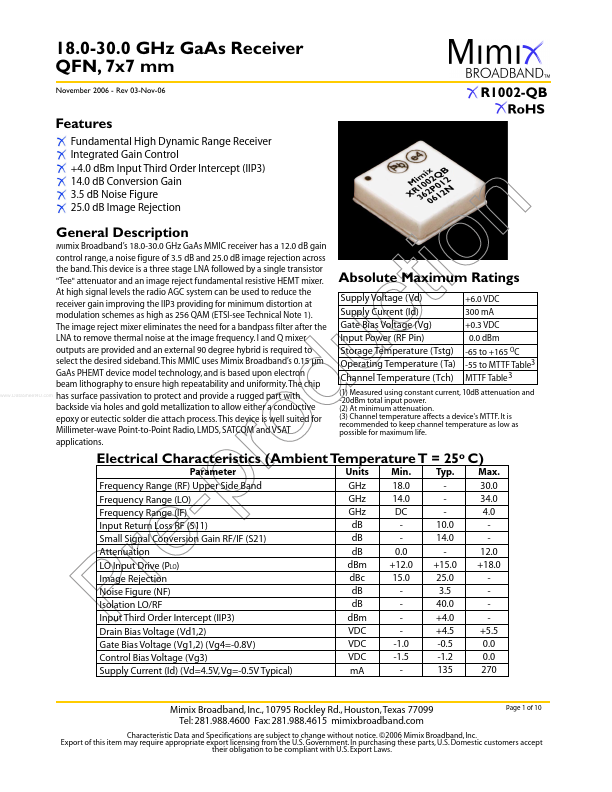
  • Fundamental High Dynamic Range Receiver Integrated Gain Control +4.0 dBm Input Third Order Intercept (IIP3) 14.0 dB Conversion Gain 3.5 dB Noise Figure 25.0 dB Image Rejection www. DataSheet4U. com Mimix Broadband’s 18.0-30.0 GHz GaAs MMIC receiver has a 12.0 dB gain control range, a noise figure of 3.5 dB and 25.0 dB image rejection across the band. This device is a three stage LNA followed by a single transistor "Tee" attenuator and an image reject fundamental resistive HEMT mixer. At high sig.

📥 Download Datasheet

Datasheet Details

Part number XR1002-QB
Manufacturer Mimix Broadband
File Size 764.73 KB
Description GaAs Receiver
Datasheet download datasheet XR1002-QB Datasheet

Full PDF Text Transcription (Reference)

The following content is an automatically extracted verbatim text from the original manufacturer datasheet and is provided for reference purposes only.

View original datasheet text
18.0-30.0 GHz GaAs Receiver QFN, 7x7 mm November 2006 - Rev 03-Nov-06 R1002-QB Features Fundamental High Dynamic Range Receiver Integrated Gain Control +4.0 dBm Input Third Order Intercept (IIP3) 14.0 dB Conversion Gain 3.5 dB Noise Figure 25.0 dB Image Rejection www.DataSheet4U.com Mimix Broadband’s 18.0-30.0 GHz GaAs MMIC receiver has a 12.0 dB gain control range, a noise figure of 3.5 dB and 25.0 dB image rejection across the band. This device is a three stage LNA followed by a single transistor "Tee" attenuator and an image reject fundamental resistive HEMT mixer. At high signal levels the radio AGC system can be used to reduce the receiver gain improving the IIP3 providing for minimum distortion at modulation schemes as high as 256 QAM (ETSI-see Technical Note 1).