Datasheet4U Logo Datasheet4U.com

N32T1630C1C - 32Mb Ultra-Low Power Asynchronous CMOS Pseudo SRAM

Datasheet Summary

Description

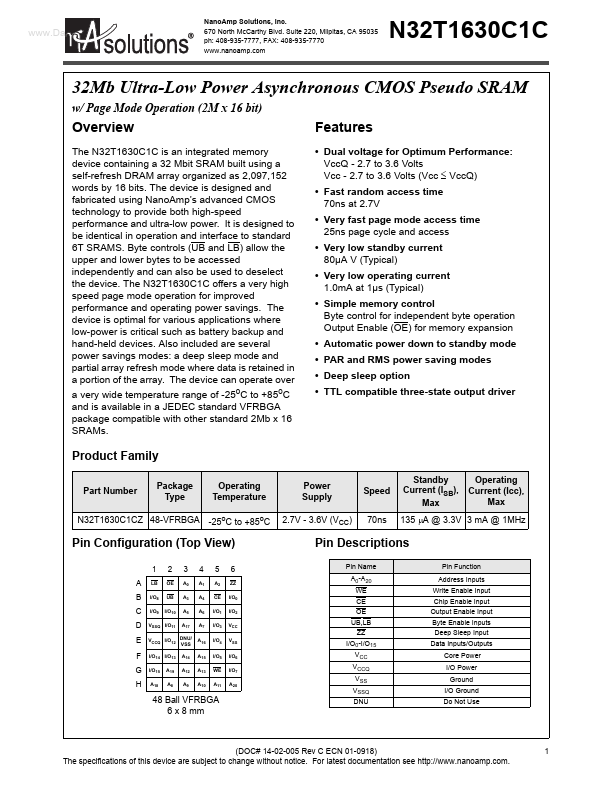
Pin Name A0-A20 WE CE OE UB,LB ZZ I/O0-I/O15 VCC VCCQ VSS VSSQ DNU Pin Function Address Inputs Write Enable Input Chip Enable Input Output Enable Input Byte Enable Inputs Deep Sleep Input Data Inputs/Outputs Core Power I/O Power Ground I/O Ground Do Not Use 2 OE UB I/O10 3 A0 A3 A5 A17 DNU/ VSS A

Features

  • Dual voltage for Optimum Performance: VccQ - 2.7 to 3.6 Volts Vcc - 2.7 to 3.6 Volts (Vcc ≤ VccQ).
  • Fast random access time 70ns at 2.7V.
  • Very fast page mode access time 25ns page cycle and access.
  • Very low standby current 80µA V (Typical).
  • Very low operating current 1.0mA at 1µs (Typical).
  • Simple memory control Byte control for independent byte operation Output Enable (OE) for memory expansion.
  • Automatic power down to standby mode.

📥 Download Datasheet

Datasheet preview – N32T1630C1C

Datasheet Details

Part number N32T1630C1C
Manufacturer NanoAmp Solutions
File Size 362.36 KB
Description 32Mb Ultra-Low Power Asynchronous CMOS Pseudo SRAM
Datasheet download datasheet N32T1630C1C Datasheet
Additional preview pages of the N32T1630C1C datasheet.
Other Datasheets by NanoAmp Solutions

Full PDF Text Transcription

Click to expand full text
www.DataSheet4U.com NanoAmp Solutions, Inc. 670 North McCarthy Blvd. Suite 220, Milpitas, CA 95035 ph: 408-935-7777, FAX: 408-935-7770 www.nanoamp.com N32T1630C1C 32Mb Ultra-Low Power Asynchronous CMOS Pseudo SRAM w/ Page Mode Operation (2M x 16 bit) Overview The N32T1630C1C is an integrated memory device containing a 32 Mbit SRAM built using a self-refresh DRAM array organized as 2,097,152 words by 16 bits. The device is designed and fabricated using NanoAmp’s advanced CMOS technology to provide both high-speed performance and ultra-low power. It is designed to be identical in operation and interface to standard 6T SRAMS. Byte controls (UB and LB) allow the upper and lower bytes to be accessed independently and can also be used to deselect the device.
Published: |