

LMH6505
LMH6505 is Variable Gain Amplifier manufactured by National Semiconductor.
..
LMH6505 Wideband, Low Power, Linear-in-d B, Variable Gain Amplifier
January 2006
LMH6505 Wideband, Low Power, Linear-in-d B, Variable Gain Amplifier
General Description
The LMH6505 is a wideband DC coupled voltage controlled gain stage followed by a high-speed current feedback op amp which can directly drive a low impedance load. The gain adjustment range is 80 d B for up to 10 MHz which is acplished by varying the gain control input voltage, VG. Maximum gain is set by external ponents, and the gain can be reduced all the way to cut-off. Power consumption is 110 m W with a speed of 150 MHz and a gain control bandwidth (BW) of 100 MHz. Output referred DC offset voltage is less than 55 m V over the entire gain control voltage range. Device-to-device gain matching is within ± 0.5 d B at maximum gain. Furthermore, gain is tested and guaranteed over a wide range. The output current feedback op amp allows high frequency large signals (Slew Rate = 1500 V/µs) and can also drive a heavy load current (60 m A) guaranteed. Near ideal input characteristics (i.e. low input bias current, low offset, low pin 3 resistance) enable the device to be easily configured as an inverting amplifier as well. To provide ease of use when working with a single supply, the VG range is set to be from 0V to +2V relative to the ground pin potential (pin 4). VG input impedance is high in order to ease drive requirement. In single supply operation, the ground pin is tied to a "virtual" half supply. The LMH6505’s gain control is linear in d B for a large portion of the total gain control range from 0 d B down to
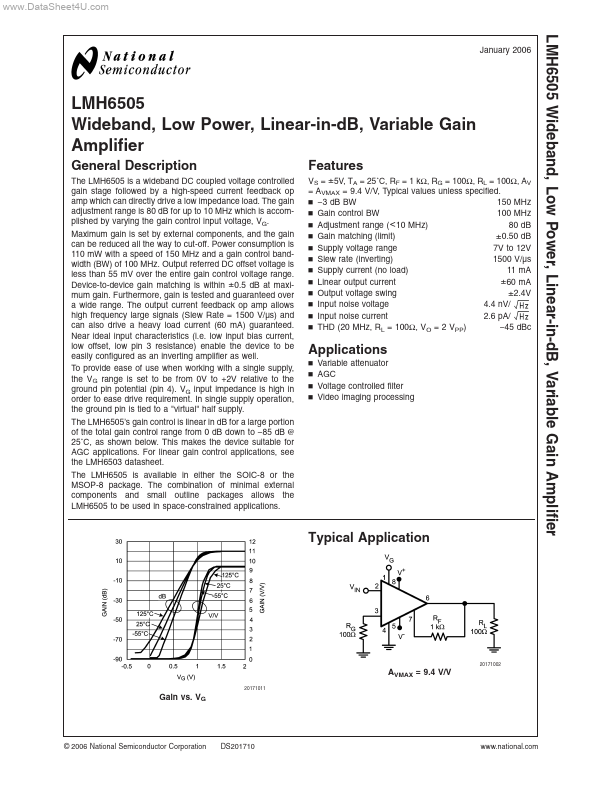
- 85 d B @ 25˚C, as shown below. This makes the device suitable for AGC applications. For linear gain control applications, see the LMH6503 datasheet. The LMH6505 is available in either the SOIC-8 or the MSOP-8 package. The bination of minimal external ponents and small outline packages allows the LMH6505 to be used in space-constrained applications.
Features
VS = ±...