PI90LVB047A
PI90LVB047A is LVDS Quad Flow-Through Differential Line Drivers manufactured by Pericom Semiconductor.
- Part of the PI90LV047A comparator family.
- Part of the PI90LV047A comparator family.
Features
- >500 Mbps (250 MHz) switching rates
- Flow-through pinout simplifies PCB layout
- Low Voltage Differential Signaling with output voltages of ±350m V into:
- 100-ohm load (PI90LV047)
- 50-ohm load (PI90LVB047)
- 300ps typical differential skew
- 400ps maximum differential skew
- 1.7ns maximum propagation delay
- 3.3V power supply design
- ±350m V differential signaling
- Bus-Pin ESD protection >10k V
- Interoperable with existing 5V LVDS receivers
- High impedance on LVDS outputs on power down
- Conforms to TIA/EIA-644 LVDS Standard
- Industrial operating temperature range (- 40°C to +85°C)
- Packages (Pb-free & Green Available):
- 16-pin SOIC (S)
- 16-pin TSSOP (L)
Description
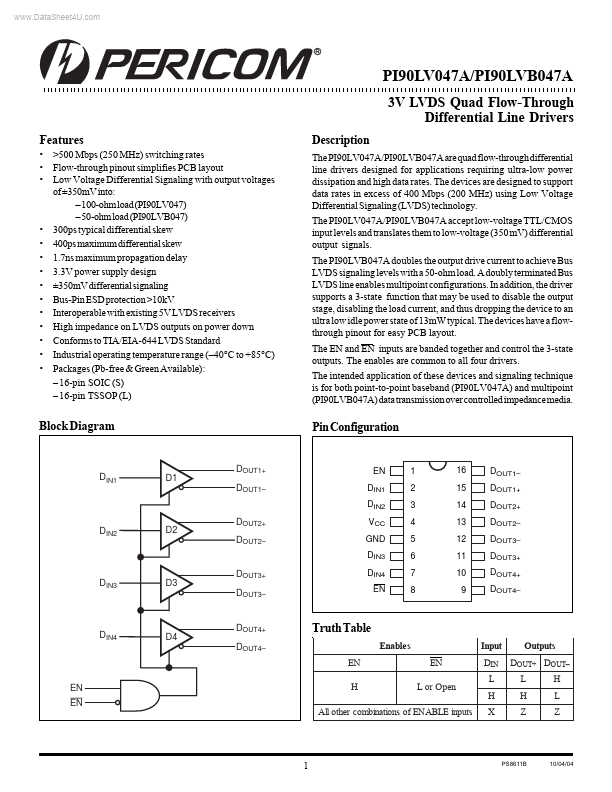
The PI90LV047A/PI90LVB047A are quad flow-through differential line drivers designed for applications requiring ultra-low power dissipation and high data rates. The devices are designed to support data rates in excess of 400 Mbps (200 MHz) using Low Voltage Differential Signaling (LVDS) technology. The PI90LV047A/PI90LVB047A accept low-voltage TTL/CMOS input levels and translates them to low-voltage (350 m V) differential output signals. The PI90LVB047A doubles the output drive current to achieve Bus LVDS signaling levels with a 50-ohm load. A doubly terminated Bus LVDS line enables multipoint configurations. In addition, the driver supports a 3-state function that may be used to disable the output stage, disabling the load current, and thus dropping the device to an ultra low idle power state of 13m W typical. The devices have a flowthrough pinout for easy PCB layout. The EN and EN inputs are banded together and control the 3-state outputs. The enables are mon to all four drivers. The intended application of these devices and signaling technique is for both point-to-point baseband (PI90LV047A) and multipoint (PI90LVB047A) data transmission over controlled impedance media.
Block Diagram
Pin Configuration
DIN1
D1
DOUT1+ DOUT1-
EN DIN1 DIN2
1 2 3 4 5 6 7 8
16 15 14 13 12 11 10...