Datasheet4U Logo Datasheet4U.com

JW1758C - Offline Step-down LED Controller

Download the JW1758C datasheet PDF. This datasheet also covers the JW1758A variant, as both devices belong to the same offline step-down led controller family and are provided as variant models within a single manufacturer datasheet.

Key Features

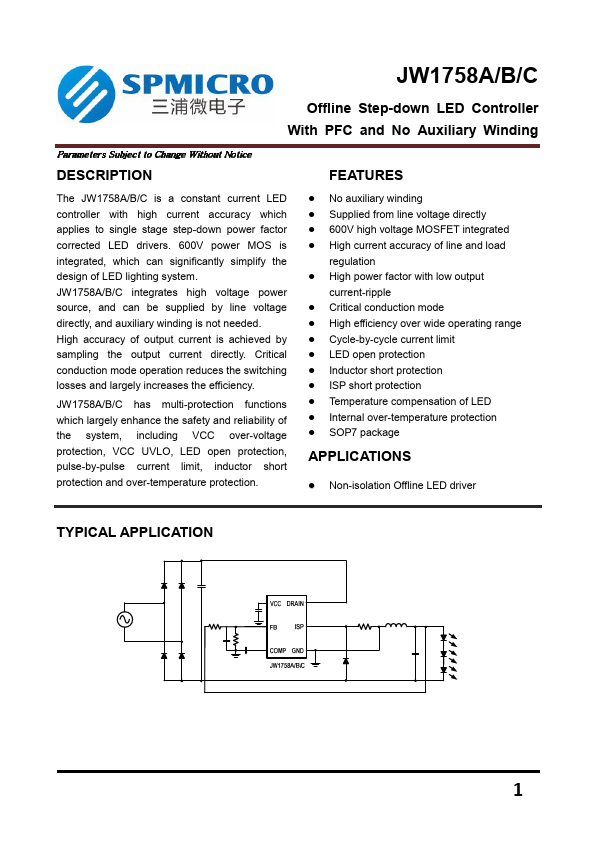
  • The JW1758A/B/C is a constant current LED controller with high current accuracy which applies to single stage step-down power factor corrected LED drivers. 600V power MOS is integrated, which can significantly simplify the design of LED lighting system. JW1758A/B/C integrates high voltage power source, and can be supplied by line voltage directly, and auxiliary winding is not needed. High accuracy of output current is achieved by sampling the output current directly. Critical conduction mode op.

📥 Download Datasheet

Note: The manufacturer provides a single datasheet file (JW1758A-SPMICRO.pdf) that lists specifications for multiple related part numbers.

Datasheet Details

Part number JW1758C
Manufacturer SPMICRO
File Size 587.89 KB
Description Offline Step-down LED Controller
Datasheet download datasheet JW1758C Datasheet

Full PDF Text Transcription (Reference)

The following content is an automatically extracted verbatim text from the original manufacturer datasheet and is provided for reference purposes only.

View original datasheet text
JW1758A/B/C Offline Step-down LED Controller With PFC and No Auxiliary Winding Parameters Subject to Change Without Notice DESCRIPTION FEATURES The JW1758A/B/C is a constant current LED controller with high current accuracy which applies to single stage step-down power factor corrected LED drivers. 600V power MOS is integrated, which can significantly simplify the design of LED lighting system. JW1758A/B/C integrates high voltage power source, and can be supplied by line voltage directly, and auxiliary winding is not needed. High accuracy of output current is achieved by sampling the output current directly. Critical conduction mode operation reduces the switching losses and largely increases the efficiency.