• Part: 74HCT390
  • Description: Dual Decade Ripple Counter
  • Manufacturer: Texas Instruments
  • Size: 521.95 KB
Download 74HCT390 Datasheet PDF
Texas Instruments
74HCT390
74HCT390 is Dual Decade Ripple Counter manufactured by Texas Instruments.
- Part of the 74HC390 comparator family.
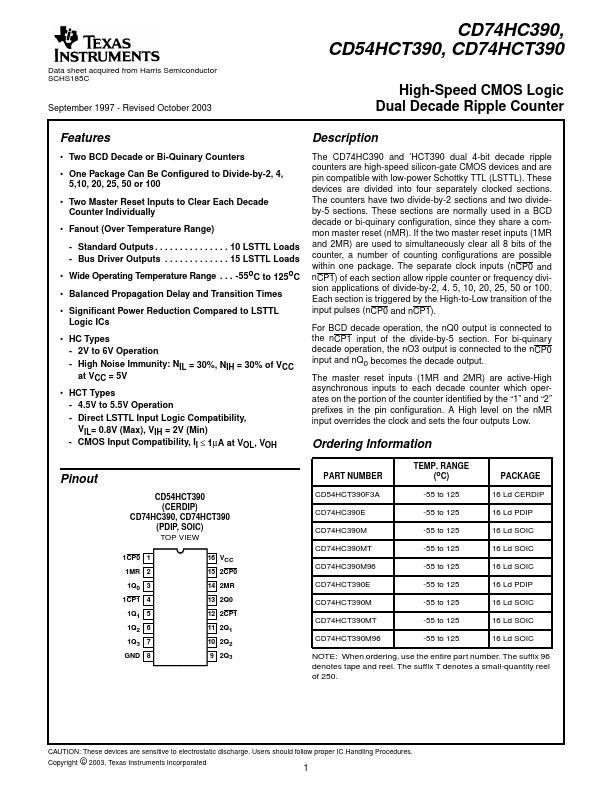
Features Description - Two BCD Decade or Bi-Quinary Counters - One Package Can Be Configured to Divide-by-2, 4, 5,10, 20, 25, 50 or 100 - Two Master Reset Inputs to Clear Each Decade Counter Individually - Fanout (Over Temperature Range) - Standard Outputs - - - 10 LSTTL Loads - Bus Driver Outputs - - . . . 15 LSTTL Loads - Wide Operating Temperature Range . . . -55o C to 125o C - Balanced Propagation Delay and Transition Times - Significant Power Reduction pared to LSTTL Logic ICs - HC Types - 2V to 6V Operation - High Noise Immunity: NIL = 30%, NIH = 30% of VCC at VCC = 5V - HCT Types - 4.5V to 5.5V Operation - Direct LSTTL Input Logic patibility, VIL= 0.8V (Max), VIH = 2V (Min) - CMOS Input patibility, Il ≤ 1µA at VOL, VOH The CD74HC390 and ’HCT390 dual 4-bit decade ripple counters are high-speed silicon-gate CMOS devices and are pin patible with low-power Schottky TTL (LSTTL). These devices are divided into four separately clocked sections. The counters have two divide-by-2 sections and two divideby-5 sections. These sections are normally used in a BCD decade or bi-quinary configuration, since they share a mon master reset (n MR). If the two master reset inputs (1MR and 2MR) are used to simultaneously clear all 8 bits of the counter, a number of counting configurations are possible within one package. The separate clock inputs (n CP0 and n CP1) of each section allow ripple counter or frequency division applications of divide-by-2, 4. 5, 10, 20, 25, 50 or 100. Each section is triggered by the High-to-Low transition of the input pulses (n CP0 and n CP1). For BCD decade operation, the n Q0 output is connected to the n CP1 input of the divide-by-5 section. For bi-quinary decade operation, the n O3 output is connected to the n CP0 input and n Q0 bees the decade output. The master reset inputs (1MR and 2MR) are active-High asynchronous inputs to each decade counter which operates on the portion of the counter identified by the “1” and “2”...