Datasheet4U Logo Datasheet4U.com

ADS6424 - Analog-to-Digital Converters

Download the ADS6424 datasheet PDF. This datasheet also covers the ADS6422 variant, as both devices belong to the same analog-to-digital converters family and are provided as variant models within a single manufacturer datasheet.

General Description

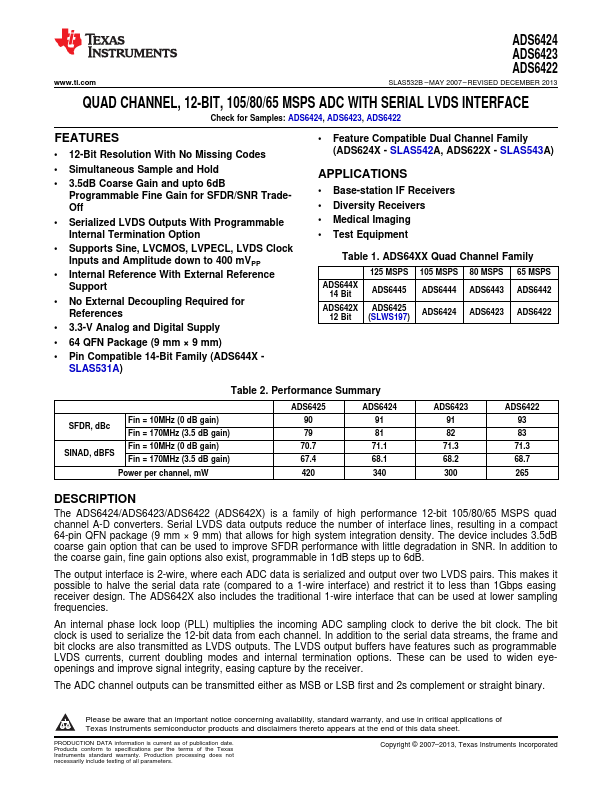
The ADS6424/ADS6423/ADS6422 (ADS642X) is a family of high performance 12-bit 105/80/65 MSPS quad channel A-D converters.

Serial LVDS data outputs reduce the number of interface lines, resulting in a compact 64-pin QFN package (9 mm × 9 mm) that allows for high system integration density.

Key Features

  • 1.
  • 12-Bit Resolution With No Missing Codes.
  • Simultaneous Sample and Hold.
  • 3.5dB Coarse Gain and upto 6dB Programmable Fine Gain for SFDR/SNR TradeOff.
  • Serialized LVDS Outputs With Programmable Internal Termination Option.
  • Supports Sine, LVCMOS, LVPECL, LVDS Clock Inputs and Amplitude down to 400 mVPP.
  • Internal Reference With External Reference Support.
  • No External Decoupling Required for References.
  • 3.3-V Analog and Digital.

📥 Download Datasheet

Note: The manufacturer provides a single datasheet file (ADS6422-etcTI.pdf) that lists specifications for multiple related part numbers.

Full PDF Text Transcription (Reference)

The following content is an automatically extracted verbatim text from the original manufacturer datasheet and is provided for reference purposes only.

View original datasheet text
www.ti.com ADS6424 ADS6423 ADS6422 SLAS532B – MAY 2007 – REVISED DECEMBER 2013 QUAD CHANNEL, 12-BIT, 105/80/65 MSPS ADC WITH SERIAL LVDS INTERFACE Check for Samples: ADS6424, ADS6423, ADS6422 FEATURES 1 • 12-Bit Resolution With No Missing Codes • Simultaneous Sample and Hold • 3.5dB Coarse Gain and upto 6dB Programmable Fine Gain for SFDR/SNR TradeOff • Serialized LVDS Outputs With Programmable Internal Termination Option • Supports Sine, LVCMOS, LVPECL, LVDS Clock Inputs and Amplitude down to 400 mVPP • Internal Reference With External Reference Support • No External Decoupling Required for References • 3.