• Part: MSA-1120
  • Description: Cascadable Silicon Bipolar MMIC Amplifier
  • Manufacturer: Hewlett-Packard
  • Size: 43.50 KB
Download MSA-1120 Datasheet PDF
Hewlett-Packard
MSA-1120
MSA-1120 is Cascadable Silicon Bipolar MMIC Amplifier manufactured by Hewlett-Packard.
- Part of the MSA-1120_Hewlett comparator family.
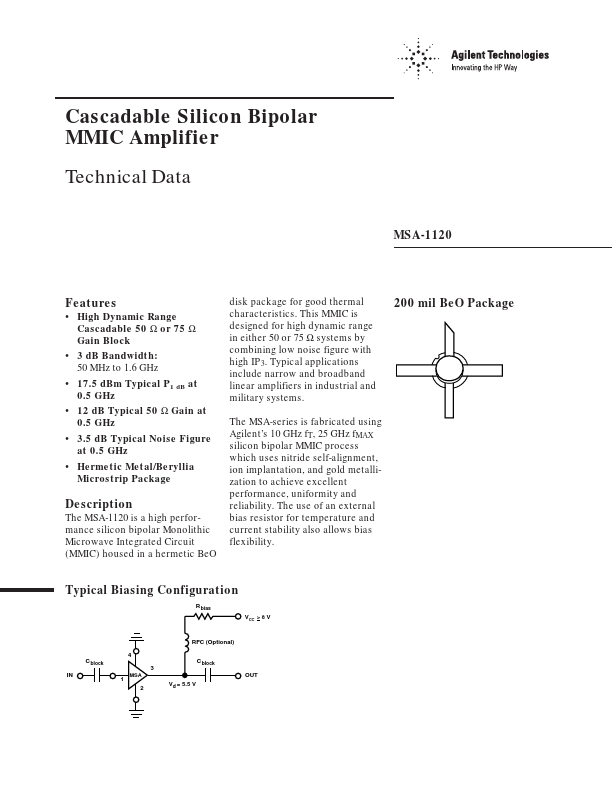
Features - High Dynamic Range Cascadable 50 Ω or 75 Ω Gain Block - 3 d B Bandwidth: 50 MHz to 1.6 GHz - 17.5 d Bm Typical P1 d B at 0.5 GHz - 12 d B Typical 50 Ω Gain at 0.5 GHz - 3.5 d B Typical Noise Figure at 0.5 GHz - Hermetic Metal/Beryllia Microstrip Package disk package for good thermal characteristics. This MMIC is designed for high dynamic range in either 50 or 75 Ω systems by bining low noise figure with high IP3. Typical applications include narrow and broadband linear amplifiers in industrial and military systems. The MSA-series is fabricated using Agilent’s 10 GHz f T, 25 GHz f MAX silicon bipolar MMIC process which uses nitride self-alignment, ion implantation, and gold metallization to achieve excellent performance, uniformity and reliability. The use of an external bias resistor for temperature and current stability also allows bias flexibility. 200 mil Be O Package Description The MSA-1120 is a high performance silicon bipolar Monolithic Microwave Integrated Circuit (MMIC) housed in a hermetic Be O Typical Biasing Configuration R bias VCC > 8 V RFC (Optional) 4 C block 3 IN 1 C block OUT Vd = 5.5 V MSA-1120 Absolute Maximum Ratings Parameter Device Current Power Dissipation[2,3] RF Input Power Junction Temperature Storage Temperature Absolute Maximum[1] 100 m A 650 m W +13 d Bm 200°C - 65 to 200°C Thermal Resistance[2,4]: θjc = 60°C/W Notes: 1. Permanent damage may occur if any of these limits are exceeded. 2. TCASE = 25°C. 3. Derate at 16.7 m W/°C for TC > 161°C. 4. The small spot size of this technique results in a higher, though more accurate determination of θjc than do alternate methods. See MEASUREMENTS section “Thermal Resistance” for more information. Electrical Specifications[1], TA = 25°C Symbol GP ∆G P f3 d B VSWR NF P1 d B IP3 t D Vd d V/d T Parameters and Test Conditions: Id = 60 m A, ZO = 50 Ω Power Gain (|S21| 2) Gain Flatness 3 d B Bandwidth[2] Input VSWR Output VSWR 50 Ω Noise Figure Output Power at 1 d B Gain pression Third Order...