

MAX3674
MAX3674 is Network Clock Synthesizer manufactured by Maxim Integrated.
Description
Features
- 21.25MHz to 1360MHz Programmable PLL Synthesized Output Clocks
- Two Differential LVPECL-patible Outputs
- Cycle-to-Cycle Jitter 1.6ps RMS and Period Jitter 0.9ps RMS at 500MHz
- On-Chip Crystal Oscillator or Selectable LVCMOS-patible Reference Clock Input
- Excellent Power-Supply Noise Rejection
- Parallel or 2-Wire I2C Programming Interface
- Lock Indicator Output
- +3.3V Power Supply
- Power Consumption: 396m W at 3.3V
- 48-Pin LQFP Pb-Free Package
- -40°C to +85°C Temperature Range
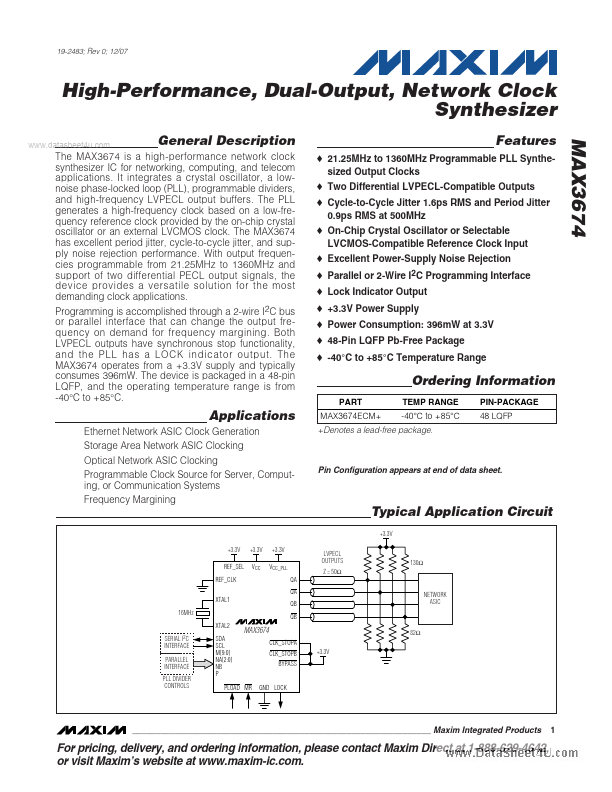
The MAX3674 is a high-performance network clock synthesizer IC for networking, puting, and tele applications. It integrates a crystal oscillator, a lownoise phase-locked loop (PLL), programmable dividers, and high-frequency LVPECL output buffers. The PLL generates a high-frequency clock based on a low-frequency reference clock provided by the on-chip crystal oscillator or an external LVCMOS clock. The MAX3674 has excellent period jitter, cycle-to-cycle jitter, and supply noise rejection performance. With output frequencies programmable from 21.25MHz to 1360MHz and support of two differential PECL output signals, the device provides a versatile solution for the most demanding clock applications. Programming is acplished through a 2-wire I2C bus or parallel interface that can change the output frequency on demand for frequency margining. Both LVPECL outputs have synchronous stop functionality, and the PLL has a LOCK indicator output. The MAX3674 operates from a +3.3V supply and typically consumes 396m W. The device is packaged in a 48-pin LQFP, and the operating temperature range is from -40°C to +85°C.
Ordering Information
PART MAX3674ECM+ TEMP RANGE -40°C to +85°C PIN-PACKAGE 48 LQFP
Applications
Ethernet Network ASIC Clock Generation Storage Area Network ASIC Clocking Optical Network ASIC Clocking Programmable Clock Source for Server, puting, or munication Systems Frequency Margining
+Denotes a lead-free package.
Pin Configuration appears at end...