PI6CV857B
PI6CV857B is 1:10 PLL Clock Driver manufactured by Pericom Semiconductor.
Features
- Operating Frequency up to 200 MHz and exceeds PC2700 RDIMM specification
- Distributes one differential clock input pair to ten differential clock output pairs.
- Inputs (CLK,CLK) and (FBIN,FBIN): SSTL_2 ..
- Input PWRDWN: LVCMOS
- Outputs (Yx, Yx), (FBOUT, FBOUT): SSTL_2
- External feedback pins (FBIN,FBIN) are used to synchronize the outputs to the clock input.
- Operates at AVDD = 2.5V for core circuit and internal PLL, and VDDQ = 2.5V for differential output drivers
- Packages (Pb-free and Green available):
- 48-pin TSSOP
Product Description
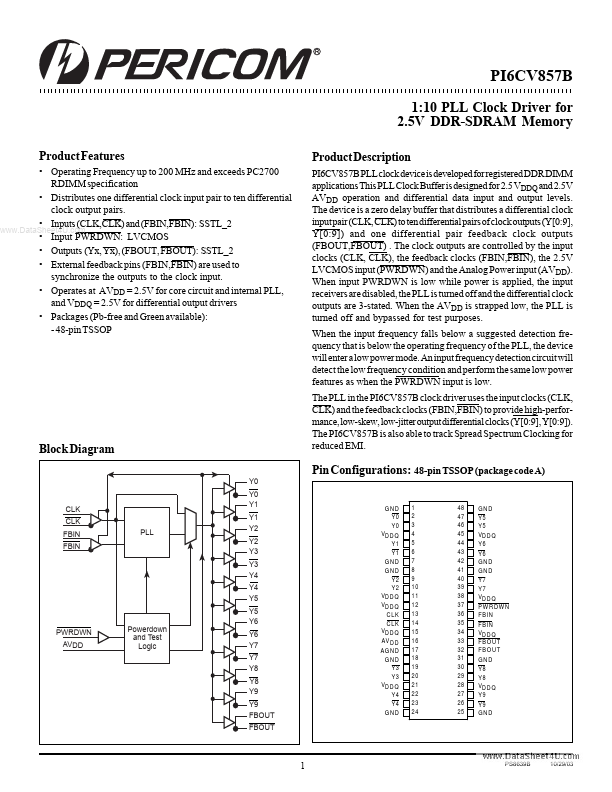
PI6CV857B PLL clock device is developed for registered DDR DIMM applications This PLL Clock Buffer is designed for 2.5 VDDQ and 2.5V AVDD operation and differential data input and output levels. The device is a zero delay buffer that distributes a differential clock input pair (CLK, CLK) to ten differential pairs of clock outputs (Y[0:9], Y[0:9]) and one differential pair feedback clock outputs (FBOUT,FBOUT) . The clock outputs are controlled by the input clocks (CLK, CLK), the feedback clocks (FBIN,FBIN), the 2.5V LVCMOS input (PWRDWN) and the Analog Power input (AVDD). When input PWRDWN is low while power is applied, the input receivers are disabled, the PLL is turned off and the differential clock outputs are 3-stated. When the AVDD is strapped low, the PLL is turned off and bypassed for test purposes. When the input frequency falls below a suggested detection frequency that is below the operating frequency of the PLL, the device will enter a low power mode. An input frequency detection circuit will detect the low frequency condition and perform the same low power features as when the PWRDWN input is low. The PLL in the PI6CV857B clock driver uses the input clocks (CLK, CLK) and the feedback clocks (FBIN,FBIN) to provide high-performance, low-skew, low-jitter output differential clocks (Y[0:9], Y[0:9]). The PI6CV857B is also able to track Spread Spectrum Clocking for reduced EMI.
Block Diagram
Y0 Y0 Y1 Y1 Y2...