Datasheet4U Logo Datasheet4U.com

MS3988N - quad DMOS full-bridge driver

Download the MS3988N datasheet PDF. This datasheet also covers the MS3988 variant, as both devices belong to the same quad dmos full-bridge driver family and are provided as variant models within a single manufacturer datasheet.

General Description

Pin NO.

Key Features

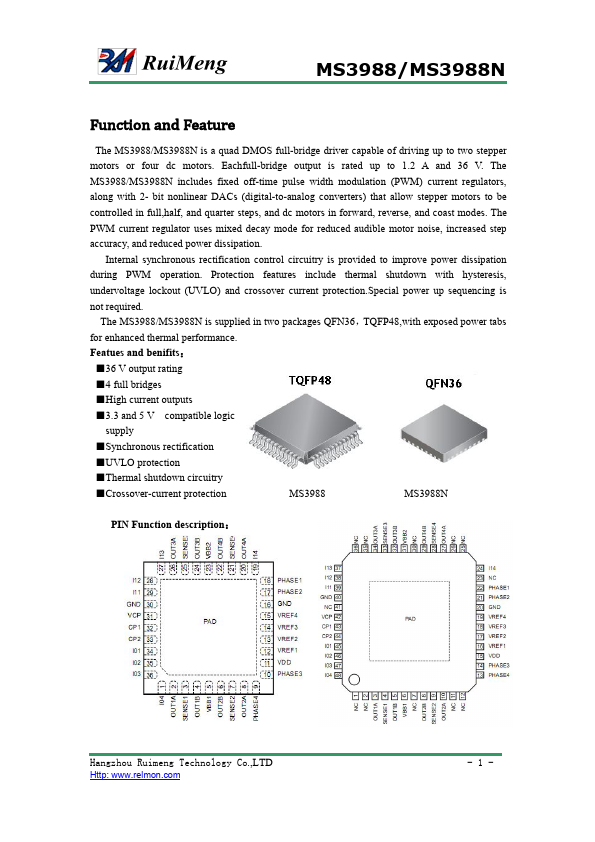
  • include thermal shutdown with hysteresis, undervoltage lockout (UVLO) and crossover current protection. Special power up sequencing is not required. The MS3988/MS3988N is supplied in two packages QFN36,TQFP48,with exposed power tabs for enhanced thermal performance. Featues and benifits:.
  • 36 V output rating.
  • 4 full bridges.
  • High current outputs.
  • 3.3 and 5 V compatible logic supply.
  • Synchronous rectification.
  • UVLO protection.
  • Thermal shutdown circuitry.

📥 Download Datasheet

Note: The manufacturer provides a single datasheet file (MS3988-Ruimeng.pdf) that lists specifications for multiple related part numbers.

Datasheet Details

Part number MS3988N
Manufacturer Ruimeng
File Size 0.96 MB
Description quad DMOS full-bridge driver
Datasheet download datasheet MS3988N Datasheet

Full PDF Text Transcription (Reference)

The following content is an automatically extracted verbatim text from the original manufacturer datasheet and is provided for reference purposes only.

View original datasheet text
MS3988/MS3988N Function and Feature The MS3988/MS3988N is a quad DMOS full-bridge driver capable of driving up to two stepper motors or four dc motors. Eachfull-bridge output is rated up to 1.2 A and 36 V. The MS3988/MS3988N includes fixed off-time pulse width modulation (PWM) current regulators, along with 2- bit nonlinear DACs (digital-to-analog converters) that allow stepper motors to be controlled in full,half, and quarter steps, and dc motors in forward, reverse, and coast modes. The PWM current regulator uses mixed decay mode for reduced audible motor noise, increased step accuracy, and reduced power dissipation. Internal synchronous rectification control circuitry is provided to improve power dissipation during PWM operation.