• Part: ADS41B49
  • Description: Ultralow-Power ADC
  • Manufacturer: Texas Instruments
  • Size: 3.49 MB
Download ADS41B49 Datasheet PDF
Texas Instruments
ADS41B49
ADS41B49 is Ultralow-Power ADC manufactured by Texas Instruments.
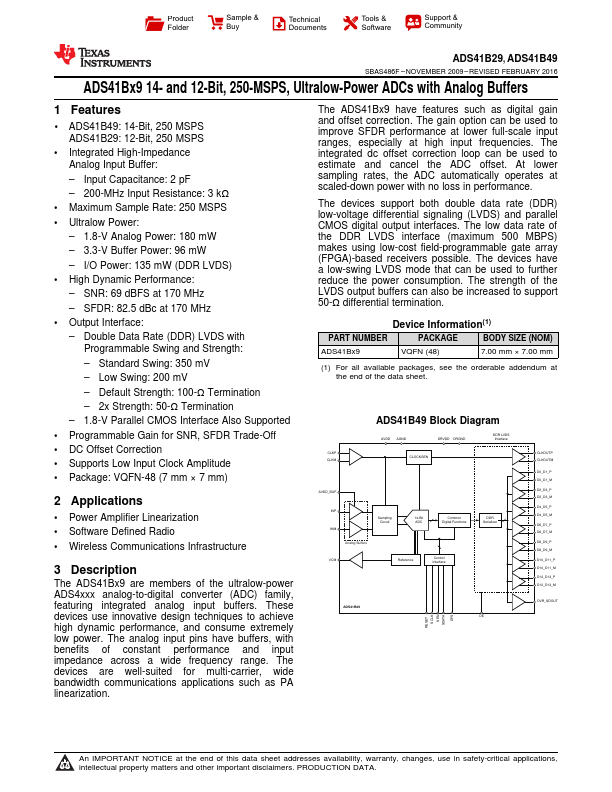
Features - 1 ADS41B49: 14-Bit, 250 MSPS ADS41B29: 12-Bit, 250 MSPS - Integrated High-Impedance Analog Input Buffer: - Input Capacitance: 2 p F - 200-MHz Input Resistance: 3 kΩ - Maximum Sample Rate: 250 MSPS - Ultralow Power: - 1.8-V Analog Power: 180 m W - 3.3-V Buffer Power: 96 m W - I/O Power: 135 m W (DDR LVDS) - High Dynamic Performance: - SNR: 69 d BFS at 170 MHz - SFDR: 82.5 d Bc at 170 MHz - Output Interface: - Double Data Rate (DDR) LVDS with Programmable Swing and Strength: - Standard Swing: 350 m V - Low Swing: 200 m V - Default Strength: 100-Ω Termination - 2x Strength: 50-Ω Termination - 1.8-V Parallel CMOS Interface Also Supported - Programmable Gain for SNR, SFDR Trade-Off - DC Offset Correction - Supports Low Input Clock Amplitude - Package: VQFN-48 (7 mm × 7 mm) 2 Applications - Power Amplifier Linearization - Software Defined Radio - Wireless munications Infrastructure 3 Description The ADS41Bx9 are members of the ultralow-power ADS4xxx analog-to-digital converter (ADC) family, featuring integrated analog input buffers. These devices use innovative design techniques to achieve high dynamic performance, and consume extremely low power. The analog input pins have buffers, with benefits of constant performance and input impedance across a wide frequency range. The devices are well-suited for multi-carrier, wide bandwidth munications applications such as PA linearization. RESET SCLK SEN SDATA DFS The ADS41Bx9 have features such as digital gain and offset correction. The gain option can be used to improve SFDR performance at lower full-scale input ranges, especially at high input frequencies. The integrated dc offset correction loop can be used to estimate and cancel the ADC offset. At lower sampling rates, the ADC automatically operates at scaled-down power with no loss in performance. The devices support both double data rate (DDR) low-voltage differential signaling (LVDS) and parallel CMOS digital output interfaces. The low data rate of the DDR LVDS...