Datasheet4U Logo Datasheet4U.com

74HCT74D - Dual D-type flip-flop

Download the 74HCT74D datasheet PDF (74HC74 included). The manufacturer datasheet provides complete specifications, pinout details, electrical characteristics, and typical applications for dual d-type flip-flop.

Description

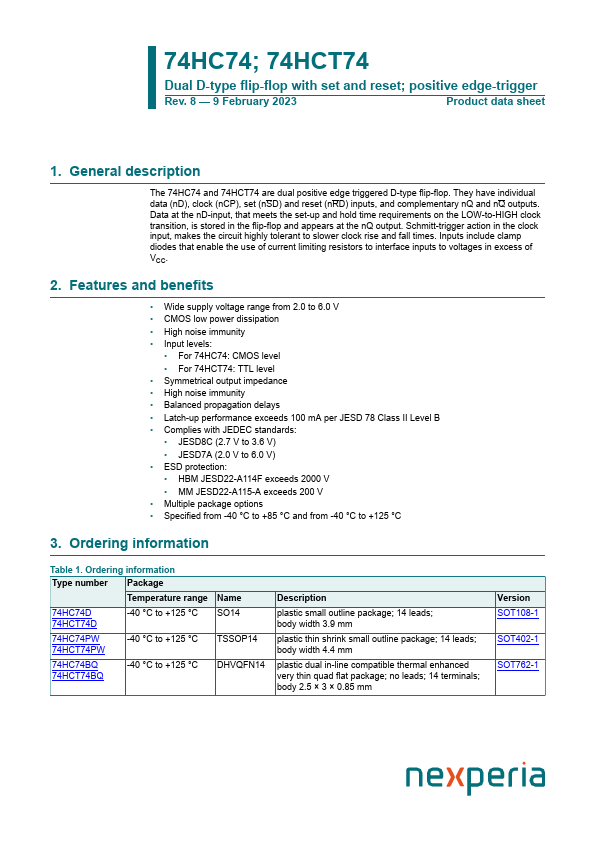
The 74HC74 and 74HCT74 are dual positive edge triggered D-type flip-flop.

They have individual data (nD), clock (nCP), set (nSD) and reset (nRD) inputs, and complementary nQ and nQ outputs.

Features

  • Wide supply voltage range from 2.0 to 6.0 V.
  • CMOS low power dissipation.
  • High noise immunity.
  • Input levels:.
  • For 74HC74: CMOS level.
  • For 74HCT74: TTL level.
  • Symmetrical output impedance.
  • High noise immunity.
  • Balanced propagation delays.
  • Latch-up performance exceeds 100 mA per JESD 78 Class II Level B.
  • Complies with JEDEC standards:.
  • JESD8C (2.7 V to 3.6 V).
  • JESD7A (2.0 V to 6.0 V.

📥 Download Datasheet

Note: The manufacturer provides a single datasheet file (74HC74-nexperia.pdf) that lists specifications for multiple related part numbers.

Datasheet Details

Part number 74HCT74D
Manufacturer nexperia
File Size 294.36 KB
Description Dual D-type flip-flop
Datasheet download datasheet 74HCT74D Datasheet
Other Datasheets by nexperia

Full PDF Text Transcription

Click to expand full text
74HC74; 74HCT74 Dual D-type flip-flop with set and reset; positive edge-trigger Rev. 8 — 9 February 2023 Product data sheet 1. General description The 74HC74 and 74HCT74 are dual positive edge triggered D-type flip-flop. They have individual data (nD), clock (nCP), set (nSD) and reset (nRD) inputs, and complementary nQ and nQ outputs. Data at the nD-input, that meets the set-up and hold time requirements on the LOW-to-HIGH clock transition, is stored in the flip-flop and appears at the nQ output. Schmitt-trigger action in the clock input, makes the circuit highly tolerant to slower clock rise and fall times. Inputs include clamp diodes that enable the use of current limiting resistors to interface inputs to voltages in excess of VCC. 2.
Published: |