Datasheet4U Logo Datasheet4U.com

MAX1823A - Dual USB Switch

This page provides the datasheet information for the MAX1823A, a member of the MAX1823 Dual USB Switch family.

Datasheet Summary

Description

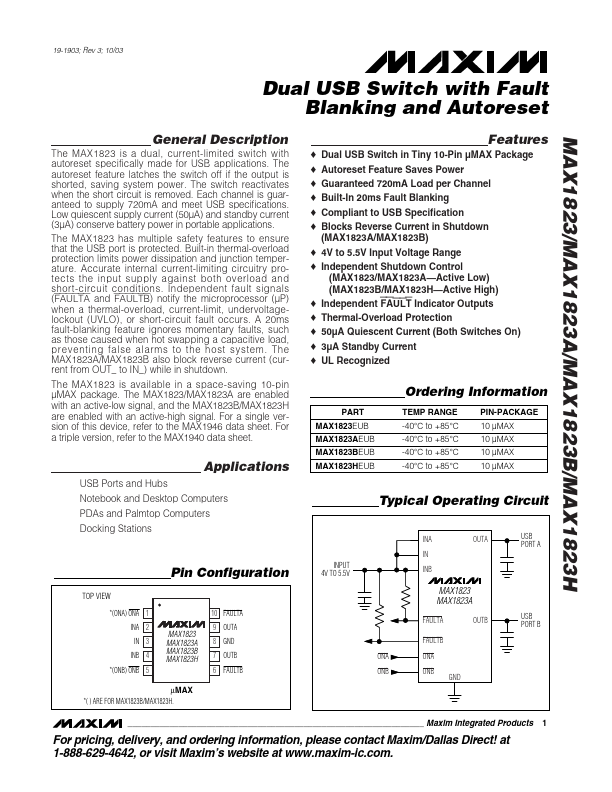
The MAX1823 is a dual, current-limited switch with autoreset specifically made for USB applications.

The autoreset feature latches the switch off if the output is shorted, saving system power.

The switch reactivates when the short circuit is removed.

Features

  • to ensure that the USB port is protected. Built-in thermal-overload protection limits power dissipation and junction temperature. Accurate internal current-limiting circuitry protects the input supply against both overload and short-circuit conditions. Independent fault signals (FAULTA and FAULTB) notify the microprocessor (µP) when a thermal-overload, current-limit, undervoltagelockout (UVLO), or short-circuit fault occurs. A 20ms fault-blanking feature ignores momentary faults, such as those c.

📥 Download Datasheet

Datasheet preview – MAX1823A

Datasheet Details

Part number MAX1823A
Manufacturer Maxim Integrated Products
File Size 302.27 KB
Description Dual USB Switch
Datasheet download datasheet MAX1823A Datasheet
Additional preview pages of the MAX1823A datasheet.
Other Datasheets by Maxim Integrated Products

Full PDF Text Transcription

Click to expand full text
19-1903; Rev 3; 10/03 MAX1823/MAX1823A/MAX1823B/MAX1823H Dual USB Switch with Fault Blanking and Autoreset General Description The MAX1823 is a dual, current-limited switch with autoreset specifically made for USB applications. The autoreset feature latches the switch off if the output is shorted, saving system power. The switch reactivates when the short circuit is removed. Each channel is guaranteed to supply 720mA and meet USB specifications. Low quiescent supply current (50µA) and standby current (3µA) conserve battery power in portable applications. The MAX1823 has multiple safety features to ensure that the USB port is protected. Built-in thermal-overload protection limits power dissipation and junction temperature.
Published: |