Datasheet4U Logo Datasheet4U.com

MAX1908 - Low-Cost Multichemistry Battery Chargers

This page provides the datasheet information for the MAX1908, a member of the MAX8765A Low-Cost Multichemistry Battery Chargers family.

Datasheet Summary

Description

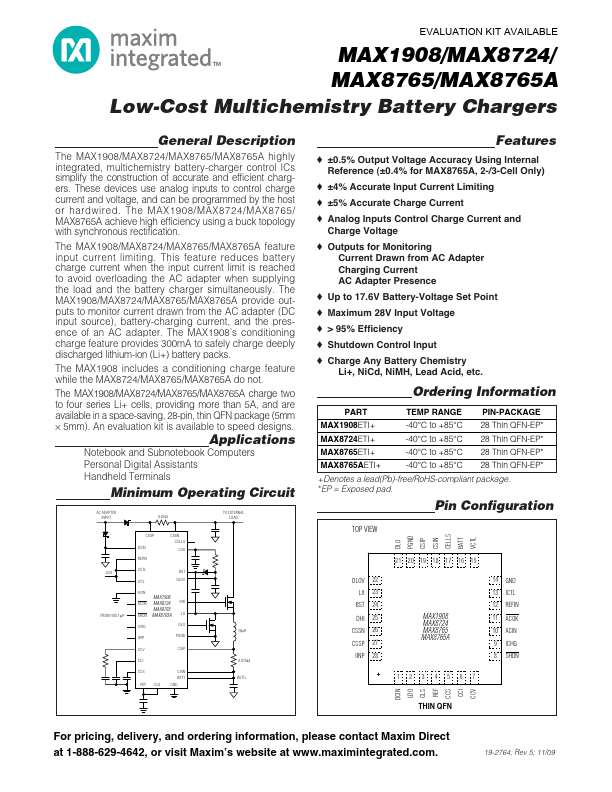
The MAX1908/MAX8724/MAX8765/MAX8765A highly integrated, multichemistry battery-charger control ICs simplify the construction of accurate and efficient chargers.

These devices use analog inputs to control charge current and voltage, and can be programmed by the host or hardwired.

Features

  • o ±0.5% Output Voltage Accuracy Using Internal Reference (±0.4% for MAX8765A, 2-/3-Cell Only) o ±4% Accurate Input Current Limiting o ±5% Accurate Charge Current o Analog Inputs Control Charge Current and Charge Voltage o Outputs for Monitoring Current Drawn from AC Adapter Charging Current AC Adapter Presence o Up to 17.6V Battery-Voltage Set Point o Maximum 28V Input Voltage o > 95% Efficiency o Shutdown Control Input o Charge Any Battery Chemistry Li+, NiCd, NiMH, Lead Acid, etc. MAX1908/MAX.

📥 Download Datasheet

Datasheet preview – MAX1908

Datasheet Details

Part number MAX1908
Manufacturer Maxim Integrated Products
File Size 845.78 KB
Description Low-Cost Multichemistry Battery Chargers
Datasheet download datasheet MAX1908 Datasheet
Additional preview pages of the MAX1908 datasheet.
Other Datasheets by Maxim Integrated Products

Full PDF Text Transcription

Click to expand full text
19-2764; Rev 5; 11/09 KIT ATION EVALU E L B A AVAIL www.DataSheet4U.com Low-Cost Multichemistry Battery Chargers General Description The MAX1908/MAX8724/MAX8765/MAX8765A highly integrated, multichemistry battery-charger control ICs simplify the construction of accurate and efficient chargers. These devices use analog inputs to control charge current and voltage, and can be programmed by the host or hardwired. The MAX1908/MAX8724/MAX8765/ MAX8765A achieve high efficiency using a buck topology with synchronous rectification. The MAX1908/MAX8724/MAX8765/MAX8765A feature input current limiting. This feature reduces battery charge current when the input current limit is reached to avoid overloading the AC adapter when supplying the load and the battery charger simultaneously.
Published: |