Datasheet4U Logo Datasheet4U.com

LM1872 - Radio Control Receiver/Decoder

This page provides the datasheet information for the LM1872, a member of the LM1 Radio Control Receiver/Decoder family.

Datasheet Summary

Description

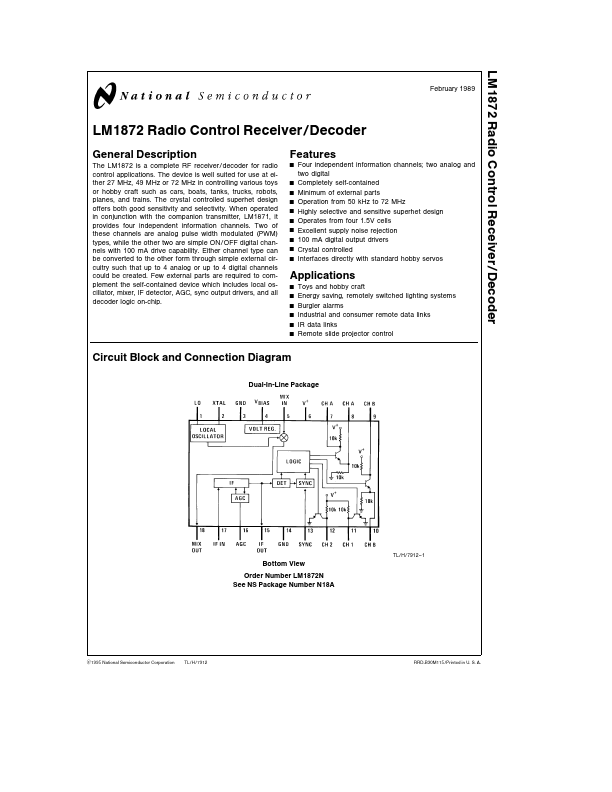
The LM1872 is a complete RF receiver decoder for radio control applications The device is well suited for use at either 27 MHz 49 MHz or 72 MHz in controlling various toys or hobby craft such as cars boats tanks trucks robots planes and trains The crystal controlled superhet design offers both good

Features

  • Y Y Y Y Y Y Y Y Y Y Four independent information channels two analog and two digital Completely self-contained Minimum of external parts Operation from 50 kHz to 72 MHz Highly selective and sensitive superhet design Operates from four 1 5V cells Excellent supply noise rejection 100 mA digital output drivers Crystal controlled Interfaces directly with standard hobby servos.

📥 Download Datasheet

Datasheet preview – LM1872

Datasheet Details

Part number LM1872
Manufacturer National Semiconductor
File Size 371.03 KB
Description Radio Control Receiver/Decoder
Datasheet download datasheet LM1872 Datasheet
Additional preview pages of the LM1872 datasheet.
Other Datasheets by National Semiconductor

Full PDF Text Transcription

Click to expand full text
LM1872 Radio Control Receiver Decoder February 1989 LM1872 Radio Control Receiver Decoder General Description The LM1872 is a complete RF receiver decoder for radio control applications The device is well suited for use at either 27 MHz 49 MHz or 72 MHz in controlling various toys or hobby craft such as cars boats tanks trucks robots planes and trains The crystal controlled superhet design offers both good sensitivity and selectivity When operated in conjunction with the companion transmitter LM1871 it provides four independent information channels Two of these channels are analog pulse width modulated (PWM) types while the other two are simple ON OFF digital channels with 100 mA drive capability Either channel type can be converted to the other form through simple external circuitry suc
Published: |