Datasheet4U Logo Datasheet4U.com

NCP1126 - High-Voltage Switcher

Download the NCP1126 datasheet PDF. This datasheet also covers the NCP1124 variant, as both devices belong to the same high-voltage switcher family and are provided as variant models within a single manufacturer datasheet.

General Description

Pin No.

This pin is connected to an external auxiliary voltage and supplies the controller.

level, the part fully latches off.

Key Features

  • include: a timer to detect an overload or a short.
  • circuit event with auto.
  • recovery or latch protection, and a built.
  • in VCC overvoltage protection. The switcher also provides a jittered 65 kHz or 100 kHz switching frequency to improve the EMI. Features.
  • Built.
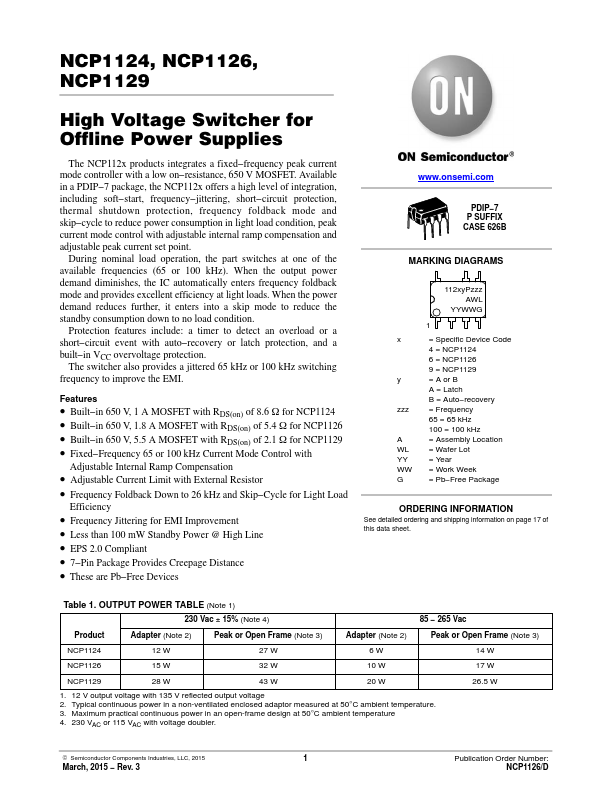
  • in 650 V, 1 A MOSFET with RDS(on) of 8.6 W for NCP1124.
  • Built.
  • in 650 V, 1.8 A MOSFET with RDS(on) of 5.4 W for NCP1126.
  • Built.
  • in 650 V, 5.5 A MOSFET with RDS(on) of 2.

📥 Download Datasheet

Note: The manufacturer provides a single datasheet file (NCP1124-ONSemiconductor.pdf) that lists specifications for multiple related part numbers.

Datasheet Details

Part number NCP1126
Manufacturer onsemi
File Size 194.13 KB
Description High-Voltage Switcher
Datasheet download datasheet NCP1126 Datasheet

Full PDF Text Transcription (Reference)

The following content is an automatically extracted verbatim text from the original manufacturer datasheet and is provided for reference purposes only.

View original datasheet text
NCP1124, NCP1126, NCP1129 High Voltage Switcher for Offline Power Supplies The NCP112x products integrates a fixed−frequency peak current mode controller with a low on−resistance, 650 V MOSFET. Available in a PDIP−7 package, the NCP112x offers a high level of integration, including soft−start, frequency−jittering, short−circuit protection, thermal shutdown protection, frequency foldback mode and skip−cycle to reduce power consumption in light load condition, peak current mode control with adjustable internal ramp compensation and adjustable peak current set point. During nominal load operation, the part switches at one of the available frequencies (65 or 100 kHz).