Datasheet4U Logo Datasheet4U.com

TC518512FL-80LV - SILICON GATE CMOS PSEUDO STATIC RAM

This page provides the datasheet information for the TC518512FL-80LV, a member of the TC518512PL-70LV SILICON GATE CMOS PSEUDO STATIC RAM family.

Datasheet Summary

Description

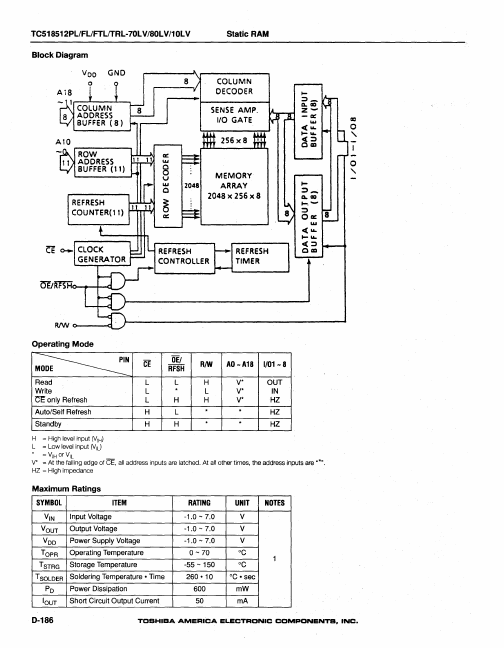
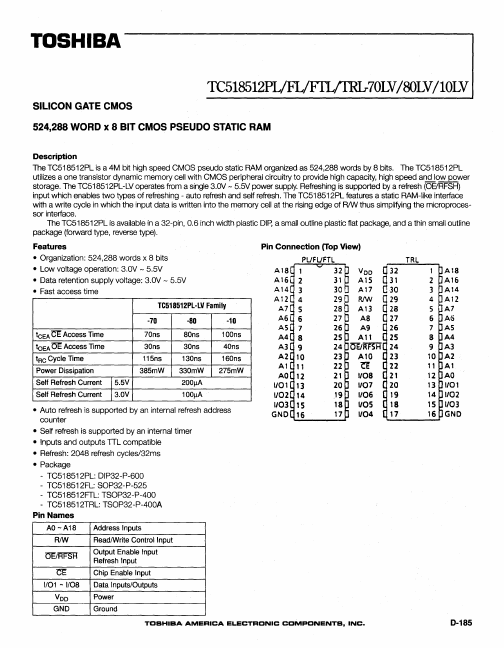
The TC518512PL is a 4M bit high speed CMOS pseudo static RAM organized as 524,288 words by 8 bits.

The TC518512PL utilizes a one transistor dynamic memory cell with CMOS peripheral circuitry to provide high capacity, high speed ar}QJow power storage.

The TC518512PL-LVoperates from a single 3.0V - 5.

Features

  • a static RAM-like interface with a write cycle in which the input data is written into the memory cell at the rising edge of RIW thus simplifying the microprocessor interface. The TC518512PL is available in a 32-pin, 0.6 inch width plastic DIP, a small outline plastic flat package, and a thin small outline package (forward type, reverse type). Features.
  • Organization: 524,288 words x 8 bits.
  • Low voltage op.

📥 Download Datasheet

Datasheet preview – TC518512FL-80LV

Datasheet Details

Part number TC518512FL-80LV
Manufacturer Toshiba
File Size 384.03 KB
Description SILICON GATE CMOS PSEUDO STATIC RAM
Datasheet download datasheet TC518512FL-80LV Datasheet
Additional preview pages of the TC518512FL-80LV datasheet.
Other Datasheets by Toshiba

Full PDF Text Transcription

Click to expand full text
TOSHIBA TC518512PL/FL/FIL!fRL70LV/80LV/I0LV SILICON GATE CMOS 524,288 WORD x 8 BIT CMOS PSEUDO STATIC RAM Description The TC518512PL is a 4M bit high speed CMOS pseudo static RAM organized as 524,288 words by 8 bits. The TC518512PL utilizes a one transistor dynamic memory cell with CMOS peripheral circuitry to provide high capacity, high speed ar}QJow power storage. The TC518512PL-LVoperates from a single 3.0V - 5.5V power supply. Refreshing is supported by a refresh (05'RFSH) input which enables two types of refreshing - auto refresh and self refresh. The TC518512PL features a static RAM-like interface with a write cycle in which the input data is written into the memory cell at the rising edge of RIW thus simplifying the microprocessor interface.
Published: |