Datasheet4U Logo Datasheet4U.com

HSC1959SP - NPN EPITAXIAL PLANAR TRANSISTOR

Download the HSC1959SP datasheet PDF. This datasheet also covers the HSC1959SP_Hi variant, as both devices belong to the same npn epitaxial planar transistor family and are provided as variant models within a single manufacturer datasheet.

General Description

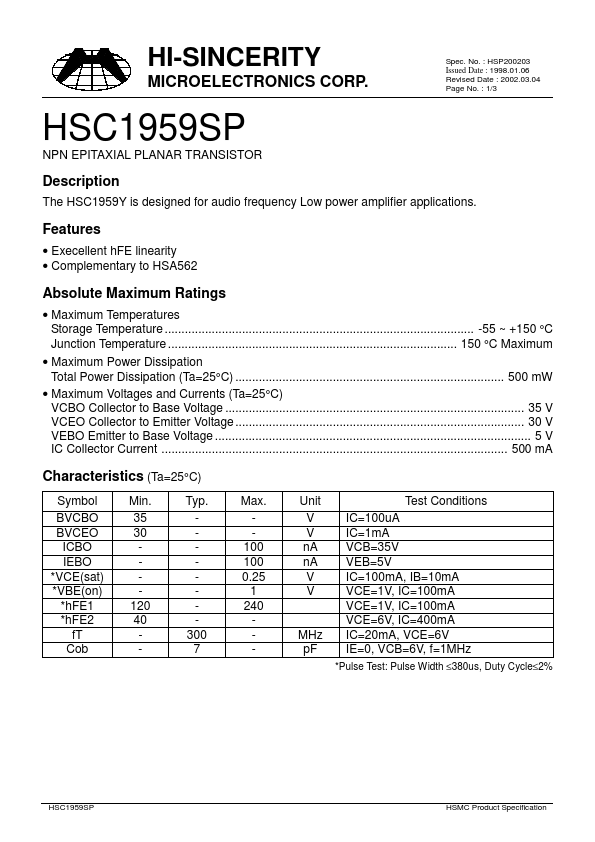
The HSC1959Y is designed for audio frequency Low power amplifier applications.

Key Features

  • Execellent hFE linearity.
  • Complementary to HSA562 Absolute Maximum Ratings.
  • Maximum Temperatures Storage Temperature -55 ~ +150 °C Junction Temperature 150 °C Maximum.
  • Maximum Power Dissipation Total Power Dissipation (Ta=25°C) 500 mW.
  • Maximum Voltages and Currents (Ta=25°C) VCBO Collector to Base Voltage 35 V VCEO Collector to Emitter Voltage.

📥 Download Datasheet

Note: The manufacturer provides a single datasheet file (HSC1959SP_Hi-SincerityMocroelectronics.pdf) that lists specifications for multiple related part numbers.

Datasheet Details

Part number HSC1959SP
Manufacturer Hi-Sincerity Mocroelectronics
File Size 27.21 KB
Description NPN EPITAXIAL PLANAR TRANSISTOR
Datasheet download datasheet HSC1959SP Datasheet

Full PDF Text Transcription (Reference)

The following content is an automatically extracted verbatim text from the original manufacturer datasheet and is provided for reference purposes only.

View original datasheet text
HI-SINCERITY MICROELECTRONICS CORP. Spec. No. : HSP200203 Issued Date : 1998.01.06 Revised Date : 2002.03.04 Page No. : 1/3 HSC1959SP NPN EPITAXIAL PLANAR TRANSISTOR Description The HSC1959Y is designed for audio frequency Low power amplifier applications. Features • Execellent hFE linearity • Complementary to HSA562 Absolute Maximum Ratings • Maximum Temperatures Storage Temperature ............................................................................................ -55 ~ +150 °C Junction Temperature ...................................................................................... 150 °C Maximum • Maximum Power Dissipation Total Power Dissipation (Ta=25°C) ................................................................................