IDT71V65902
IDT71V65902 is Synchronous ZBT SRAMs manufactured by IDT.
- Part of the IDT71V65702 comparator family.
- Part of the IDT71V65702 comparator family.
Features
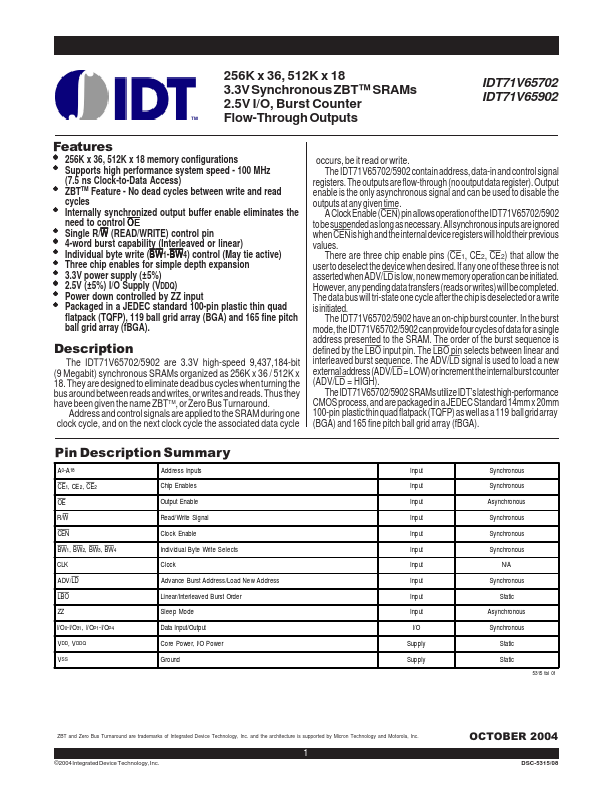
256K x 36, 512K x 18 memory configurations Supports high performance system speed
- 100 MHz (7.5 ns Clock-to-Data Access) ZBTTM Feature
- No dead cycles between write and read cycles Internally synchronized output buffer enable eliminates the need to control OE Single R/W (READ/WRITE) control pin 4-word burst capability (Interleaved or linear) Individual byte write (BW1-BW4) control (May tie active) Three chip enables for simple depth expansion 3.3V power supply (±5%) 2.5V (±5%) I/O Supply (VDDQ) Power down controlled by ZZ input Packaged in a JEDEC standard 100-pin plastic thin quad flatpack (TQFP), 119 ball grid array (BGA) and 165 fine pitch ball grid array (f BGA).
Description
The IDT71V65702/5902 are 3.3V high-speed 9,437,184-bit (9 Megabit) synchronous SRAMs organized as 256K x 36 / 512K x 18. They are designed to eliminate dead bus cycles when turning the bus around between reads and writes, or writes and reads. Thus they have been given the name ZBTTM, or Zero Bus Turnaround. Address and control signals are applied to the SRAM during one clock cycle, and on the next clock cycle the associated data cycle occurs, be it read or write. The IDT71V65702/5902 contain address, data-in and control signal registers. The outputs are flow-through (no output data register). Output enable is the only asynchronous signal and can be used to disable the outputs at any given time. A Clock Enable (CEN) pin allows operation of the IDT71V65702/5902 to be suspended as long as necessary. All synchronous inputs are ignored when CEN is high and the internal device registers will hold their previous values. There are three chip enable pins (CE1, CE2, CE2) that allow the user to deselect the device when desired. If any one of these three is not asserted when ADV/LD is low, no new memory operation can be initiated. However, any pending data transfers (reads or writes) will be pleted. The data bus will tri-state one cycle after the chip is deselected or a write is initiated....