ML65L245
ML65L245 is High Speed Octal Buffer Transceivers manufactured by Micro Linear.
- Part of the ML65L245CS comparator family.
- Part of the ML65L245CS comparator family.
DESCRIPTION
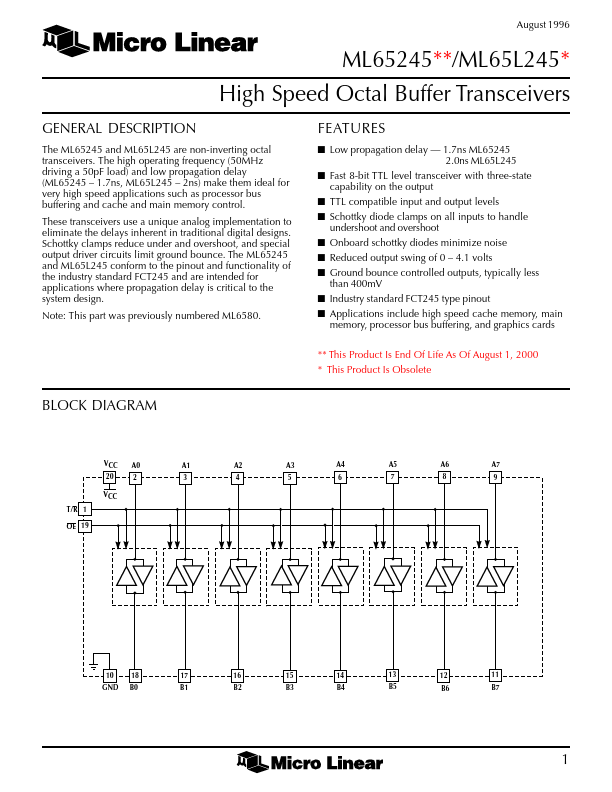
The ML65245 and ML65L245 are non-inverting octal transceivers. The high operating frequency (50MHz driving a 50p F load) and low propagation delay (ML65245
- 1.7ns, ML65L245
- 2ns) make them ideal for very high speed applications such as processor bus buffering and cache and main memory control.
These transceivers use a unique analog implementation to eliminate the delays inherent in traditional digital designs. Schottky clamps reduce under and overshoot, and special output driver circuits limit ground bounce. The ML65245 and ML65L245 conform to the pinout and functionality of the industry standard FCT245 and are intended for applications where propagation delay is critical to the system design.
Note: This part was previously numbered ML6580.
FEATURES s Low propagation delay
- 1.7ns ML65245 2.0ns ML65L245 s Fast 8-bit TTL level transceiver with three-state capability on the output s...