SN55LVDS33-SP
SN55LVDS33-SP is HIGH-SPEED DIFFERENTIAL RECEIVER manufactured by Texas Instruments.
FEATURES
- 400-Mbps Signaling Rate and 200-Mxfr/s Data Transfer Rate (1)
- Operates With a Single 3.3-V Supply
- - 4 V to 5 V mon-Mode Input Voltage
Range
- Differential Input Thresholds < ±50 m V With
50 m V of Hysteresis Over Entire mon Mode Input Voltage Range
- plies With TIA/EIA-644 (LVDS)
- Active Failsafe Assures a High-Level Output With No Input
- Bus-Pin ESD Protection Exceeds 15-k V HBM
- Input Remains High-Impedance On Power Down
- TTL Inputs Are 5-V Tolerant
- QML-V Qualified, SMD 5962-07248
- Military Temperature Range (- 55°C to 125°C)
(1) The signaling rate of a line is the number of voltage transitions that are made per second expressed in the units bps (bits per second).
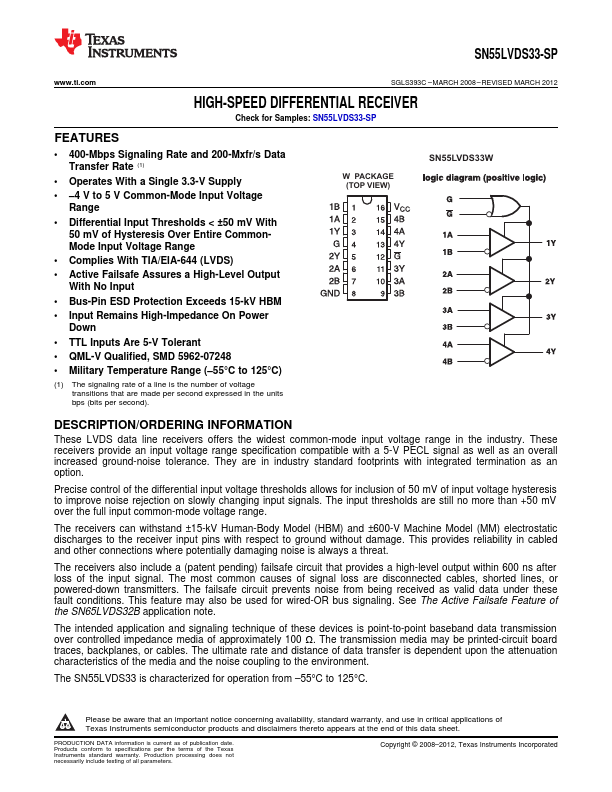
W PACKAGE (TOP VIEW)
SN55LVDS33W
DESCRIPTION
/ORDERING INFORMATION
These LVDS data line receivers offers the widest mon-mode input voltage range in the industry. These receivers provide an input voltage range specification patible with a 5-V PECL signal as well as an overall increased ground-noise tolerance. They are in industry standard footprints with integrated termination as an option.
Precise control of the differential input voltage thresholds allows for inclusion of 50 m V of input voltage hysteresis to improve noise rejection on slowly changing input signals. The input thresholds are still no more than +50 m V over the full input mon-mode voltage range.
The receivers can withstand ±15-k V Human-Body Model (HBM) and ±600-V Machine Model (MM) electrostatic discharges to the receiver input pins with respect to ground without damage. This provides reliability in cabled and other connections where potentially damaging noise is always a threat.
The receivers also include a (patent pending) failsafe circuit that provides a high-level output within 600 ns after loss of the input signal. The most mon causes of signal loss are disconnected cables, shorted lines, or powered-down transmitters. The failsafe circuit prevents noise from being received as valid data under these fault...