SN75LVDS83A
SN75LVDS83A is Transmitters manufactured by Texas Instruments.
Features
- 1 LVDS Display Ser Des Interfaces Directly to LCD Display Panels with Integrated LVDS
- Package Options: 8.1 mm × 14 mm TSSOP
- 3.3-V Tolerant Data Inputs
- Transfer Rate up to 100 Mpps (Mega Pixel Per
Second)
- Pixel Clock Frequency Range: 10 MHz to 100
MHz
- Suited for Display Resolutions Ranging From
HVGA up to HD With Low EMI
- Operates From a Single 3.3-V Supply and
170 m W (Typical) at 75 MHz
- 28 Data Channels Plus Clock In Low-Voltage TTL to 4 Data Channels Plus Clock Out Low-Voltage Differential
- Consumes Less Than 1 m W When Disabled
- Selectable Rising or Falling Clock Edge Triggered Inputs
- ESD: 5000 V HBM
- Support Spread Spectrum Clocking (SSC)
- patible With all OMAP™ 2x, OMAP™ 3x, and Da Vinci™ Application Processors
2 Applications
- Tablets
- Industrial PC, Laptop, and Other Factory
Automation Displays
- Patient Monitor and Medical Equipment Displays
- Electronic Point-of-Sale (EPOS) Displays
- Printer Displays
3 Description
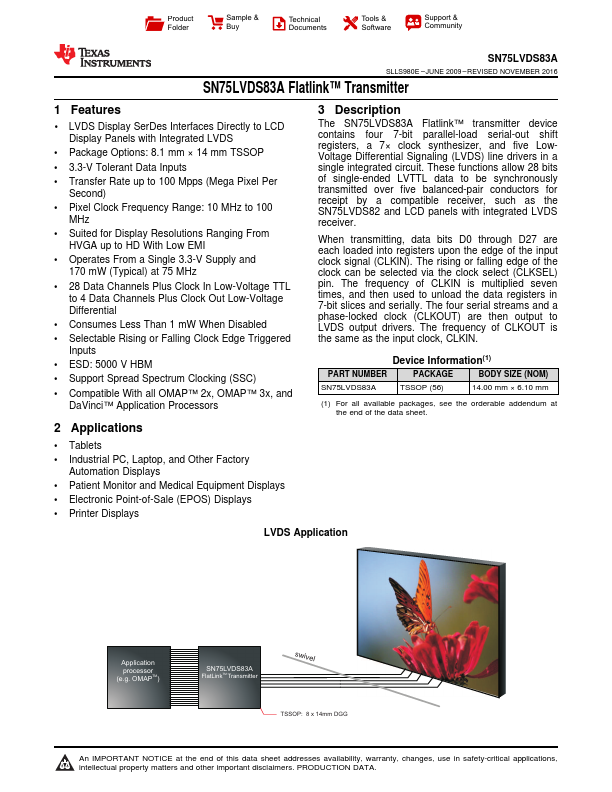
The SN75LVDS83A Flatlink™ transmitter device contains four 7-bit parallel-load serial-out shift registers, a 7× clock synthesizer, and five Low Voltage Differential Signaling (LVDS) line drivers in a single integrated circuit. These functions allow 28 bits of single-ended LVTTL data to be synchronously transmitted over five balanced-pair conductors for receipt by a patible receiver, such as the SN75LVDS82 and LCD panels with integrated LVDS receiver.
When transmitting, data bits D0 through D27 are each loaded into registers upon the edge of the input clock signal (CLKIN). The rising or falling edge of the clock can be selected via the clock select (CLKSEL) pin. The frequency of CLKIN is multiplied seven times, and then used to unload the data registers in 7-bit slices and serially. The four serial streams and a phase-locked clock (CLKOUT) are then output to LVDS output drivers. The frequency of CLKOUT is the same as the input clock, CLKIN.
Device Information(1)
PART NUMBER
PACKAGE
BODY SIZE (NOM)
TSSOP...