Datasheet4U Logo Datasheet4U.com

MAX34409 - SMBus Dual/Quad Current Monitor

This page provides the datasheet information for the MAX34409, a member of the MAX34408 SMBus Dual/Quad Current Monitor family.

Datasheet Summary

Description

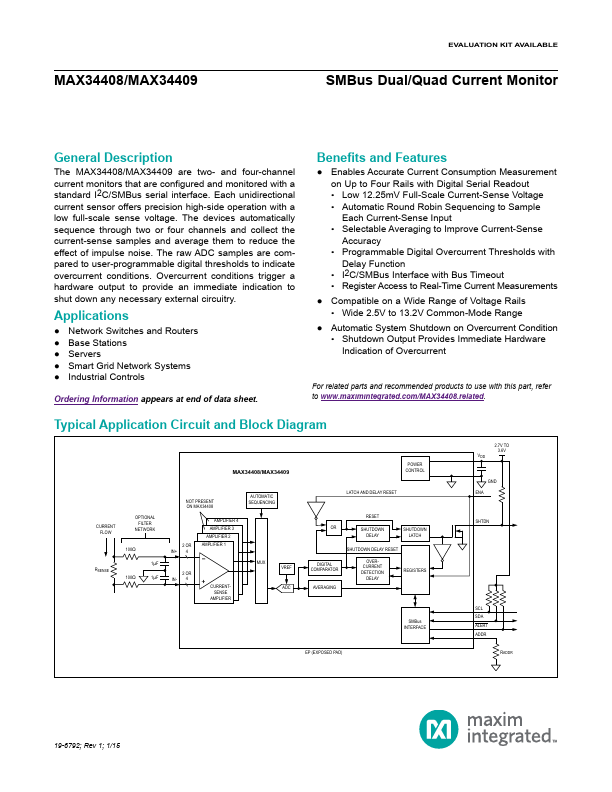
The MAX34408/MAX34409 are two- and four-channel current monitors that are configured and monitored with a standard I2C/SMBus serial interface.

Each unidirectional current sensor offers precision high-side operation with a low full-scale sense voltage.

Features

  • Enables Accurate Current Consumption Measurement on Up to Four Rails with Digital Serial Readout.
  • Low 12.25mV Full-Scale Current-Sense Voltage.
  • Automatic Round Robin Sequencing to Sample Each Current-Sense Input.
  • Selectable Averaging to Improve Current-Sense Accuracy.
  • Programmable Digital Overcurrent Thresholds with Delay Function.
  • I2C/SMBus Interface with Bus Timeout.
  • Register Access to Real-Time Current Measurements.
  • Comp.

📥 Download Datasheet

Datasheet preview – MAX34409

Datasheet Details

Part number MAX34409
Manufacturer Maxim Integrated
File Size 636.97 KB
Description SMBus Dual/Quad Current Monitor
Datasheet download datasheet MAX34409 Datasheet
Additional preview pages of the MAX34409 datasheet.
Other Datasheets by Maxim Integrated

Full PDF Text Transcription

Click to expand full text
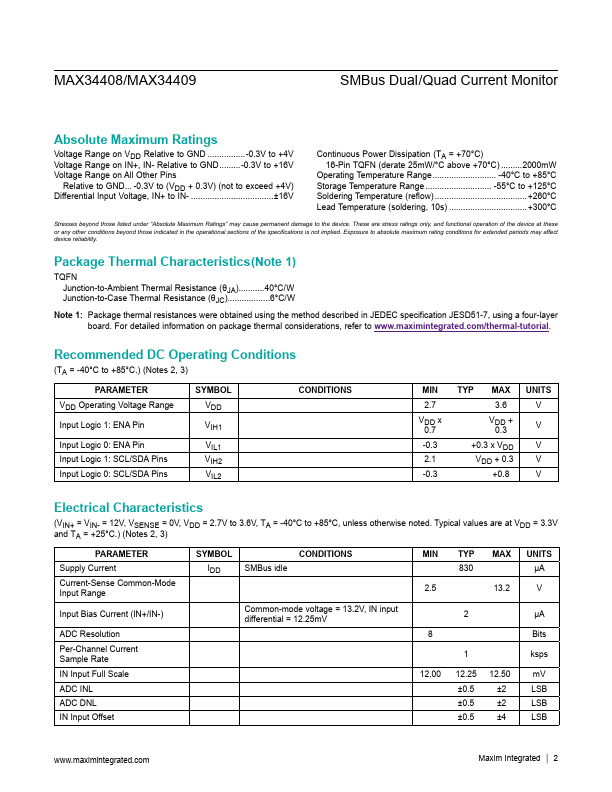
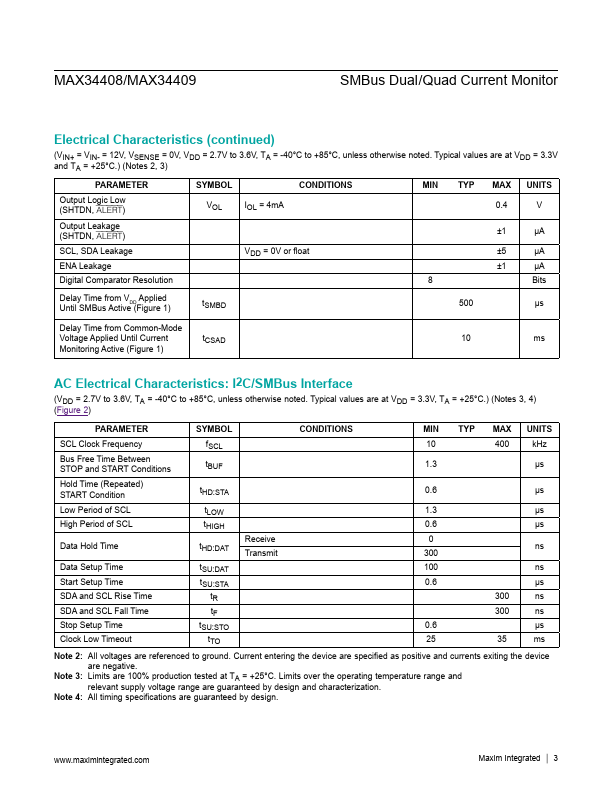
MAX34408/MAX34409 EVALUATION KIT AVAILABLE SMBus Dual/Quad Current Monitor General Description The MAX34408/MAX34409 are two- and four-channel current monitors that are configured and monitored with a standard I2C/SMBus serial interface. Each unidirectional current sensor offers precision high-side operation with a low full-scale sense voltage. The devices automatically sequence through two or four channels and collect the current-sense samples and average them to reduce the effect of impulse noise. The raw ADC samples are compared to user-programmable digital thresholds to indicate overcurrent conditions. Overcurrent conditions trigger a hardware output to provide an immediate indication to shut down any necessary external circuitry.
Published: |