Datasheet4U Logo Datasheet4U.com

74HCT107-Q100 - Dual JK flip-flop

This page provides the datasheet information for the 74HCT107-Q100, a member of the 74HC107-Q100 Dual JK flip-flop family.

Description

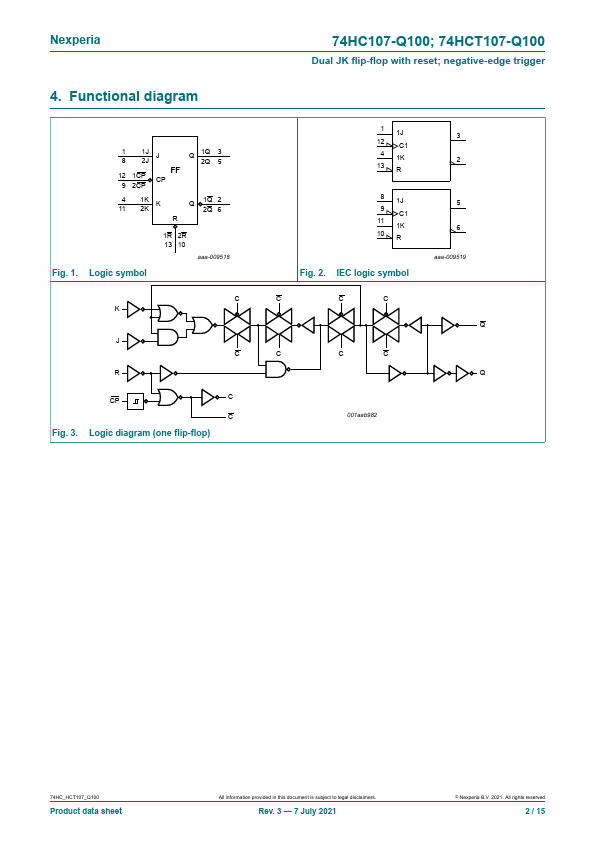
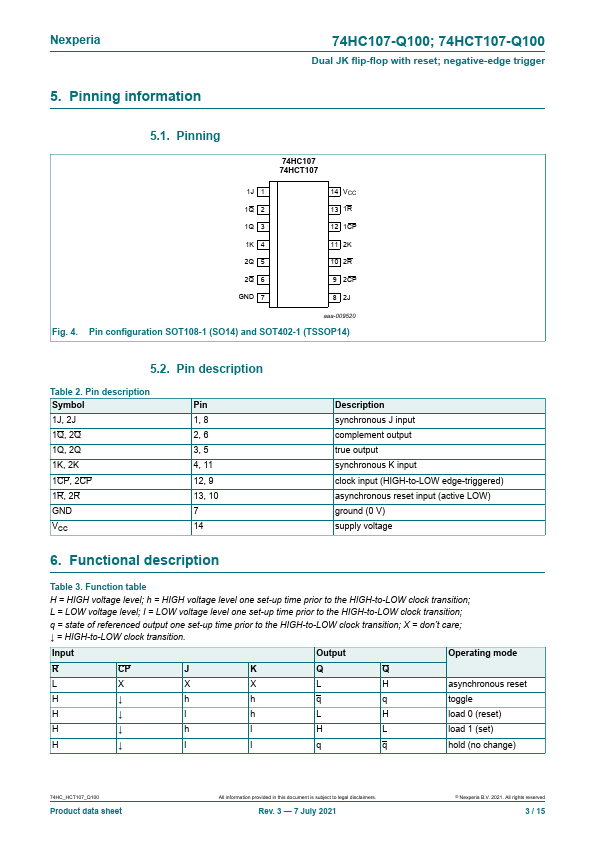
The 74HC107-Q100; 74HCT107-Q100 is a dual negative edge triggered JK flip-flop featuring individual J and K inputs, clock (CP) and reset (R) inputs and complementary Q and Q outputs.

The reset is an asynchronous active LOW input and operates independently of the clock input.

Features

  • Automotive product qualification in accordance with AEC-Q100 (Grade 1).
  • Specified from -40 °C to +85 °C and from -40 °C to +125 °C.
  • Wide supply voltage range from 2.0 V to 6.0 V.
  • CMOS low power dissipation.
  • High noise immunity.
  • Latch-up performance exceeds 100 mA per JESD 78 Class II Level B.
  • Complies with JEDEC standards:.
  • JESD8C (2.7 V to 3.6 V).
  • JESD7A (2.0 V to 6.0 V).
  • Input levels:.
  • For 74HC1.

📥 Download Datasheet

Datasheet preview – 74HCT107-Q100

Datasheet Details

Part number 74HCT107-Q100
Manufacturer nexperia
File Size 254.58 KB
Description Dual JK flip-flop
Datasheet download datasheet 74HCT107-Q100 Datasheet
Additional preview pages of the 74HCT107-Q100 datasheet.
Other Datasheets by nexperia

Full PDF Text Transcription

Click to expand full text
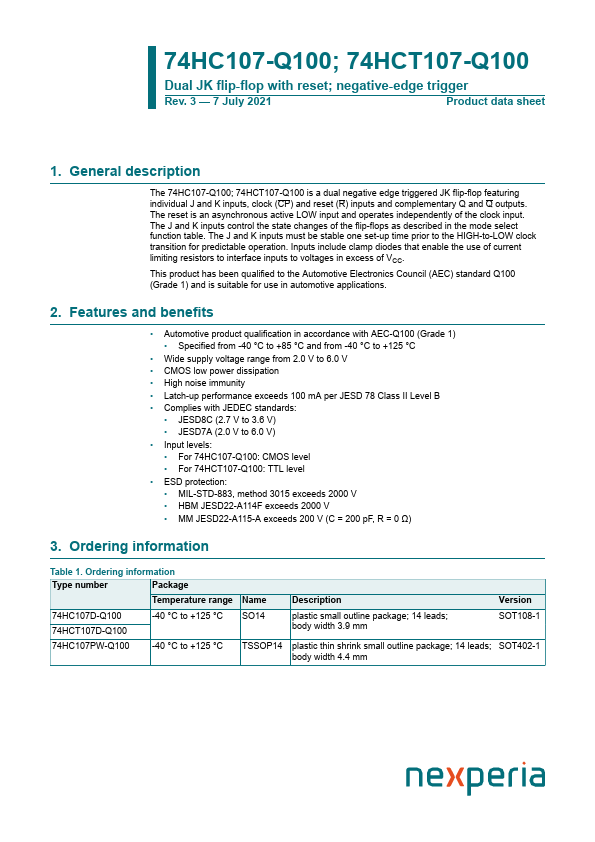
74HC107-Q100; 74HCT107-Q100 Dual JK flip-flop with reset; negative-edge trigger Rev. 3 — 7 July 2021 Product data sheet 1. General description The 74HC107-Q100; 74HCT107-Q100 is a dual negative edge triggered JK flip-flop featuring individual J and K inputs, clock (CP) and reset (R) inputs and complementary Q and Q outputs. The reset is an asynchronous active LOW input and operates independently of the clock input. The J and K inputs control the state changes of the flip-flops as described in the mode select function table. The J and K inputs must be stable one set-up time prior to the HIGH-to-LOW clock transition for predictable operation. Inputs include clamp diodes that enable the use of current limiting resistors to interface inputs to voltages in excess of VCC.
Published: |