GVT71512B18
GVT71512B18 is 256K x 36 / 512K x 18 Sunchronous Burse Flowthrough SRAM manufactured by Cypress.
- Part of the GVT71256B36 comparator family.
- Part of the GVT71256B36 comparator family.
( Data Sheet : .. )
1CY7C1361A
CY7C1361A/GVT71256B36 CY7C1363A/GVT71512B18
256K x 36/512K x 18 Synchronous Burst Flowthrough SRAM
Features
- -
- -
- -
- -
- -
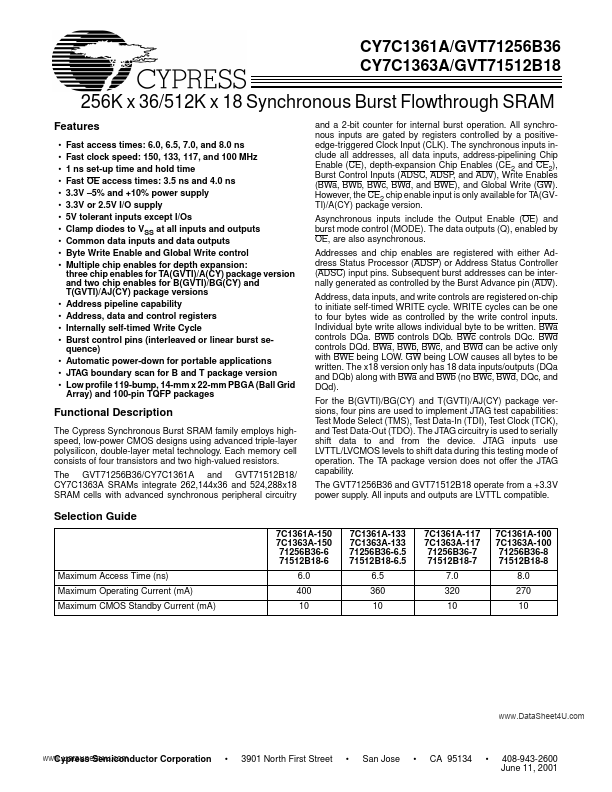
- Fast access times: 6.0, 6.5, 7.0, and 8.0 ns Fast clock speed: 150, 133, 117, and 100 MHz 1 ns set-up time and hold time Fast OE access times: 3.5 ns and 4.0 ns 3.3V
- 5% and +10% power supply 3.3V or 2.5V I/O supply 5V tolerant inputs except I/Os Clamp diodes to VSS at all inputs and outputs mon data inputs and data outputs Byte Write Enable and Global Write control Multiple chip enables for depth expansion: three chip enables for TA(GVTI)/A(CY) package version and two chip enables for B(GVTI)/BG(CY) and T(GVTI)/AJ(CY) package versions Address pipeline capability Address, data and control registers Internally self-timed Write Cycle Burst control pins (interleaved or linear burst sequence) Automatic power-down for portable applications JTAG boundary scan for B and T package version Low profile 119-bump, 14-mm x 22-mm PBGA (Ball Grid Array) and 100-pin TQFP packages and a 2-bit counter for internal burst operation. All synchronous inputs are gated by registers controlled by a positiveedge-triggered Clock Input (CLK). The synchronous inputs include all addresses, all data inputs, address-pipelining Chip Enable (CE), depth-expansion Chip Enables (CE2 and CE2), , and ADV), Write Enables Burst Control Inputs (ADSC, ADSP (BWa, BWb, BWc, BWd, and BWE), and Global Write (GW). However, the CE2 chip enable input is only available for TA(GVTI)/A(CY) package version. Asynchronous inputs include the Output Enable (OE) and burst mode control (MODE). The data outputs (Q), enabled by OE, are also asynchronous. Addresses and chip enables are registered with either Address Status Processor (ADSP) or Address Status Controller (ADSC) input pins. Subsequent burst addresses can be internally generated as controlled by the Burst Advance pin (ADV). Address, data inputs, and write controls are registered...