• Part: CDCVF2509
  • Description: 3.3-V PHASE-LOCK LOOP CLOCK DRIVER
  • Manufacturer: Texas Instruments
  • Size: 400.27 KB
Download CDCVF2509 Datasheet PDF
Texas Instruments
CDCVF2509
CDCVF2509 is 3.3-V PHASE-LOCK LOOP CLOCK DRIVER manufactured by Texas Instruments.
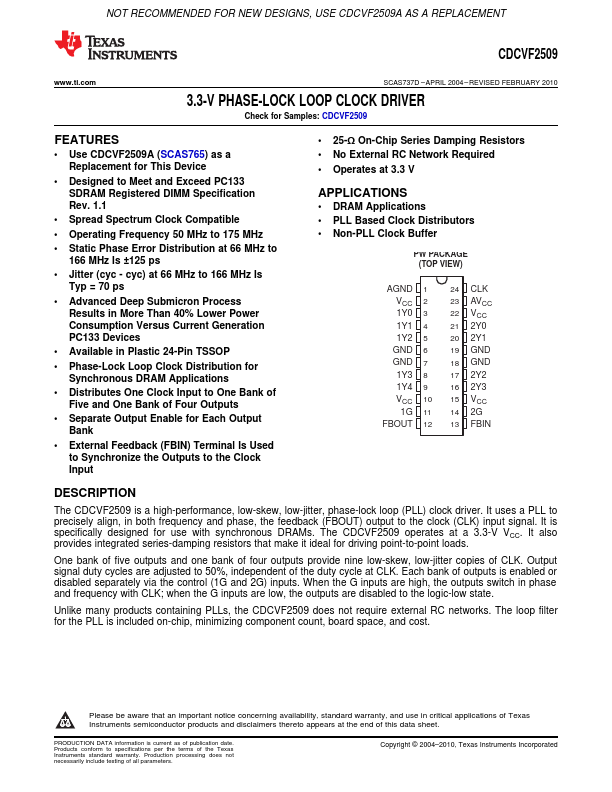
FEATURES - Use CDCVF2509A (SCAS765) as a Replacement for This Device - Designed to Meet and Exceed PC133 SDRAM Registered DIMM Specification Rev. 1.1 - Spread Spectrum Clock patible - Operating Frequency 50 MHz to 175 MHz - Static Phase Error Distribution at 66 MHz to 166 MHz Is ±125 ps - Jitter (cyc - cyc) at 66 MHz to 166 MHz Is Typ = 70 ps - Advanced Deep Submicron Process Results in More Than 40% Lower Power Consumption Versus Current Generation PC133 Devices - Available in Plastic 24-Pin TSSOP - Phase-Lock Loop Clock Distribution for Synchronous DRAM Applications - Distributes One Clock Input to One Bank of Five and One Bank of Four Outputs - Separate Output Enable for Each Output Bank - External Feedback (FBIN) Terminal Is Used to Synchronize the Outputs to the Clock Input - 25-Ω On-Chip Series Damping Resistors - No External RC Network Required - Operates at 3.3 V APPLICATIONS - DRAM Applications - PLL Based Clock Distributors - Non-PLL Clock Buffer PW PACKAGE (TOP VIEW) AGND 1 VCC 2 1Y0 3 1Y1 4 1Y2 5 GND 6 GND 7 1Y3 8 1Y4 9 VCC 10 1G 11 FBOUT 12 24 CLK 23 AVCC 22 VCC 21 2Y0 20 2Y1 19 GND 18 GND 17 2Y2 16 2Y3 15 VCC 14 2G 13 FBIN DESCRIPTION The CDCVF2509 is a high-performance, low-skew, low-jitter, phase-lock loop (PLL) clock driver. It uses a PLL to precisely align, in both frequency and phase, the feedback (FBOUT) output to the clock (CLK) input signal. It is specifically designed for use with synchronous DRAMs. The CDCVF2509 operates at a 3.3-V VCC. It also provides integrated series-damping resistors that make it ideal for driving point-to-point loads. One bank of five outputs and one bank of four outputs provide nine low-skew, low-jitter copies of CLK. Output signal duty cycles are adjusted to 50%, independent of the duty cycle at CLK. Each bank of outputs is enabled or disabled separately via the control (1G and 2G) inputs. When the G inputs are high, the outputs switch in phase and frequency with CLK; when the G inputs are low, the outputs are...