Datasheet4U Logo Datasheet4U.com

SN65LVDS390 - High-Speed Differential Line Receivers

Download the SN65LVDS390 datasheet PDF. This datasheet also covers the SN65 variant, as both devices belong to the same high-speed differential line receivers family and are provided as variant models within a single manufacturer datasheet.

📥 Download Datasheet

Note: The manufacturer provides a single datasheet file (SN65-LVDT390.pdf) that lists specifications for multiple related part numbers.

General Description

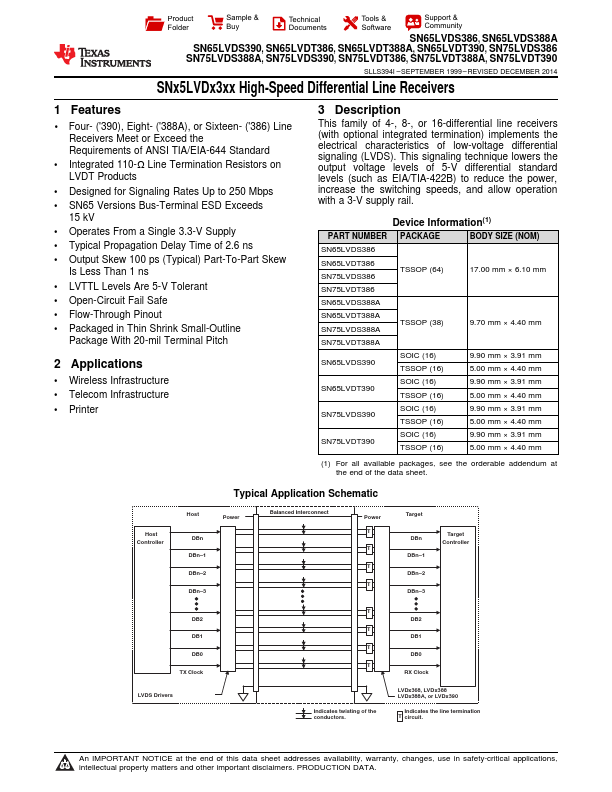
This family of 4-, 8-, or 16-differential line receivers (with optional integrated termination) implements the electrical characteristics of low-voltage differential signaling (LVDS).

This signaling technique lowers the output voltage levels of 5-V differential standard levels (such as EIA/TIA-422B) to reduce the power, increase the switching speeds, and allow operation with a 3-V supply rail.

Device Information(1) PART NUMBER PACKAGE BODY SIZE (NOM) SN65LVDS386 SN65LVDT386 SN75LVDS386 TSSOP (64) 17.00 mm × 6.10 mm SN75LVDT386 SN65LVDS388A SN65LVDT388A SN75LVDS388A TSSOP (38) 9.70 mm × 4.40 mm SN75LVDT388A SN65LVDS390 SOIC (16) TSSOP (16) 9.90 mm × 3.91 mm 5.00 mm × 4.40 mm SN65LVDT390 SOIC (16) TSSOP (16) 9.90 mm × 3.91 mm 5.00 mm × 4.40 mm SN75LVDS390 SOIC (16) TSSOP (16) 9.90 mm × 3.91 mm 5.00 mm × 4.40 mm SN75LVDT390 SOIC (16) TSSOP (16) 9.90 mm × 3.91 mm 5.00 mm × 4.40 mm (1) For all available packages, see the order

Overview

Product Folder Sample & Buy Technical Documents Tools & Software Support & Community SN65LVDS386, SN65LVDS388A SN65LVDS390, SN65LVDT386, SN65LVDT388A, SN65LVDT390, SN75LVDS386 SN75LVDS388A, SN75LVDS390, SN75LVDT386,.

Key Features

  • 1 Four- ('390), Eight- ('388A), or Sixteen- ('386) Line Receivers Meet or Exceed the Requirements of ANSI TIA/EIA-644 Standard.
  • Integrated 110-Ω Line Termination Resistors on LVDT Products.
  • Designed for Signaling Rates Up to 250 Mbps.
  • SN65 Versions Bus-Terminal ESD Exceeds 15 kV.
  • Operates From a Single 3.3-V Supply.
  • Typical Propagation Delay Time of 2.6 ns.
  • Output Skew 100 ps (Typical) Part-To-Part Skew Is Less Than 1 ns.
  • LV.