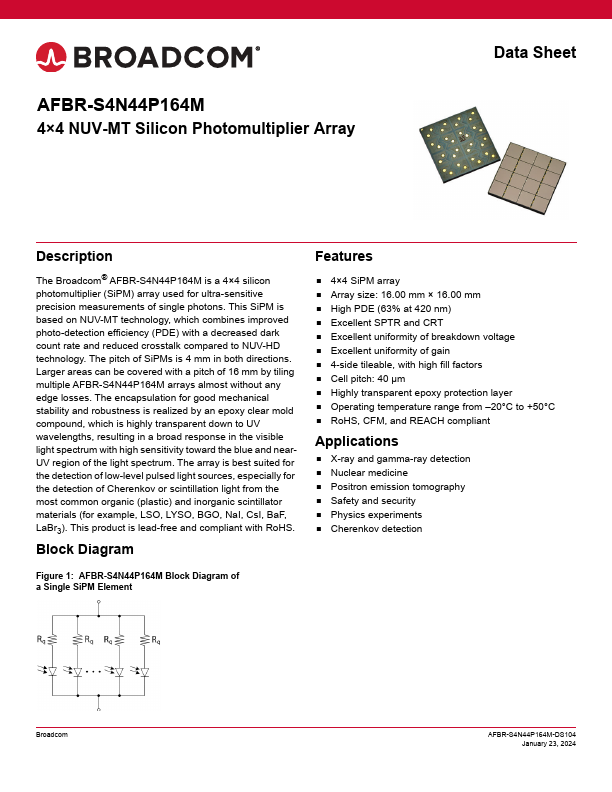
AFBR-S4N44P164M
AFBR-S4N44P164M is 4 x 4 NUV-MT Silicon Photomultiplier Array manufactured by Broadcom.
Description
The Broad® AFBR-S4N44P164M is a 4×4 silicon photomultiplier (Si PM) array used for ultra-sensitive precision measurements of single photons. This Si PM is based on NUV-MT technology, which bines improved photo-detection efficiency (PDE) with a decreased dark count rate and reduced crosstalk pared to NUV-HD technology. The pitch of Si PMs is 4 mm in both directions. Larger areas can be covered with a pitch of 16 mm by tiling multiple AFBR-S4N44P164M arrays almost without any edge losses. The encapsulation for good mechanical stability and robustness is realized by an epoxy clear mold pound, which is highly transparent down to UV wavelengths, resulting in a broad response in the visible light spectrum with high sensitivity toward the blue and near UV region of the light spectrum. The array is best suited for the detection of low-level pulsed light sources, especially for the detection of Cherenkov or scintillation light from the most mon organic (plastic) and inorganic scintillator materials (for example, LSO, LYSO, BGO, Na I, Cs I, Ba F, La Br3). This product is lead-free and pliant with Ro HS.
Block Diagram
Features
- 4×4 Si PM array
- Array size: 16.00 mm × 16.00 mm
- High PDE (63% at 420 nm)
- Excellent SPTR and CRT
- Excellent uniformity of breakdown voltage
- Excellent uniformity of gain
- 4-side tileable, with high fill factors
- Cell pitch: 40 μm
- Highly transparent epoxy protection layer
- Operating temperature range from
- 20°C to +50°C
- Ro HS, CFM, and REACH pliant
Applications
- X-ray and gamma-ray detection
- Nuclear medicine
- Positron emission tomography
- Safety and security
- Physics experiments
- Cherenkov detection
Figure 1: AFBR-S4N44P164M Block Diagram of a Single Si PM Element
Broad
AFBR-S4N44P164M-DS104 January 23, 2024
AFBR-S4N44P164M Data Sheet
Pad Layout
4×4 NUV-MT Silicon Photomultiplier Array
The AFBR-S4N44P164M has 32 signal pins. The anode and the cathode of each Si PM chip can be connected separately. The cathodes do not have a...