Datasheet4U Logo Datasheet4U.com

STPMC1 - Programmable poly-phase energy calculator IC

Datasheet Summary

Description

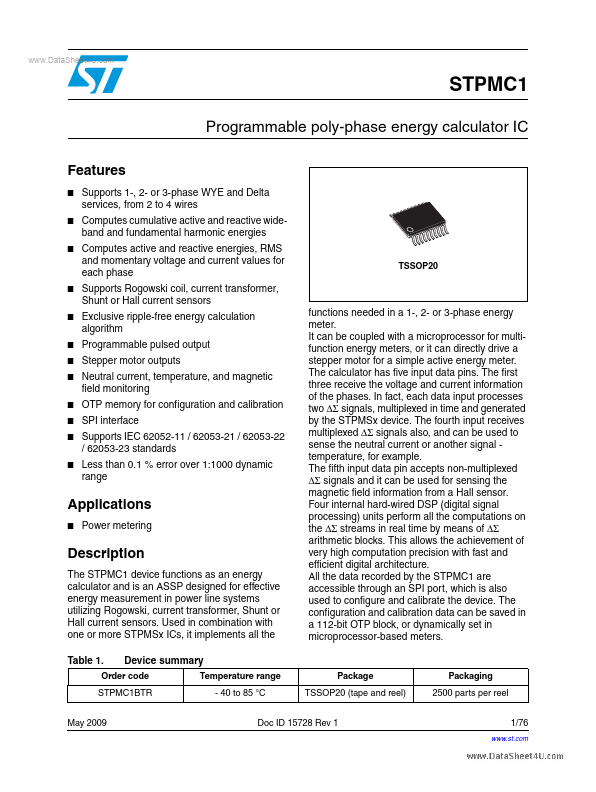
The STPMC1 device functions as an energy calculator and is an ASSP designed for effective energy measurement in power line systems utilizing Rogowski, current transformer, Shunt or Hall current sensors.

Used in combination with one or more STPMSx ICs, it implements all the Table 1.

Features

  • Supports 1-, 2- or 3-phase WYE and Delta services, from 2 to 4 wires Computes cumulative active and reactive wideband and fundamental harmonic energies Computes active and reactive energies, RMS and momentary voltage and current values for each phase Supports Rogowski coil, current transformer, Shunt or Hall current sensors Exclusive ripple-free energy calculation algorithm Programmable pulsed output Stepper motor outputs Neutral current, temperature, and magnetic field monito.

📥 Download Datasheet

Datasheet preview – STPMC1

Datasheet Details

Part number STPMC1
Manufacturer STMicroelectronics
File Size 2.86 MB
Description Programmable poly-phase energy calculator IC
Datasheet download datasheet STPMC1 Datasheet
Additional preview pages of the STPMC1 datasheet.
Other Datasheets by ST Microelectronics

Full PDF Text Transcription

Click to expand full text
www.DataSheet4U.com STPMC1 Programmable poly-phase energy calculator IC Features ■ ■ ■ Supports 1-, 2- or 3-phase WYE and Delta services, from 2 to 4 wires Computes cumulative active and reactive wideband and fundamental harmonic energies Computes active and reactive energies, RMS and momentary voltage and current values for each phase Supports Rogowski coil, current transformer, Shunt or Hall current sensors Exclusive ripple-free energy calculation algorithm Programmable pulsed output Stepper motor outputs Neutral current, temperature, and magnetic field monitoring OTP memory for configuration and calibration SPI interface Supports IEC 62052-11 / 62053-21 / 62053-22 / 62053-23 standards Less than 0.1 % error over 1:1000 dynamic range functions needed in a 1-, 2- or 3-phase energy meter.
Published: |